EU Vape Logistics Shipping Customs and Traceability
A container of e-cigarettes sits on the quay because the commercial invoice describes the goods as “vaporiser devices”, the EU-CEG notification receipt names a different model string, and the batch codes printed on the cartons do not appear anywhere on the packing list. Nobody disputes the nicotine strength and nobody has opened a carton. The consignment is stuck on paper. For wholesale buyers importing into the EU, clearance is won or lost in the document set, and the most expensive delays come from three fields that do not match: the model identifier, the importer identity and the lot number. This article stays on that side of the work, transport documents, the customs declaration and the batch record, and leaves the wider rulebook to the EU vape wholesale compliance guide.
1. What customs examines when a vape consignment lands
A customs officer assessing an e-cigarette consignment works from the declaration, not from the full text of Directive 2014/40/EU. The declaration needs an EORI number, a named Importer of Record, a tariff heading, a customs value and a supporting set of papers that agree with one another. Nicotine-containing e-cigarettes are often entered under tariff heading 8543.70 and related subheadings, but the actual classification must be confirmed with your customs broker or the competent customs authority before the goods are declared; no rate or binding ruling is assumed here. PuffCell’s shipping policy describes how a consignment is handed over to the carrier; what follows is the paperwork that travels with it.
The six-month notification is a market-access file, not a shipping document
Article 20(2) of the TPD requires the manufacturer or importer to notify the competent authority of each Member State six months before placing a product on the market, with ingredients, emissions, toxicological data, nicotine dose and uptake, and a description of the device and production process. That submission runs through the EU-CEG portal in the common format set by Commission Implementing Decision (EU) 2015/2183. Customs rarely asks to see it at arrival, but a recall or a market-surveillance request will, so the notification receipt belongs in the same file as the invoice, not in a separate marketing folder.
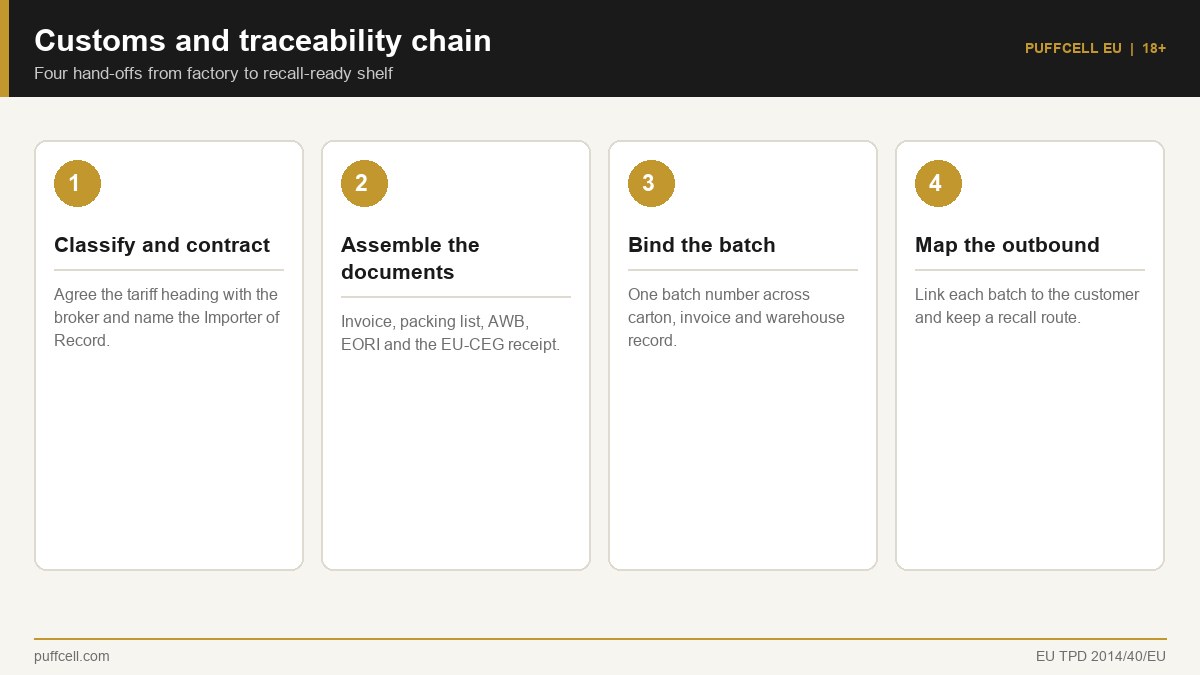
Before the truck or container moves, assemble the clearance pack in this order:
- File the EORI number and the Importer of Record legal name, address and VAT data on the declaration header.
- Attach the commercial invoice with the exact model string, quantity per model and the incoterm used for the customs value.
- Attach the packing list with carton counts, gross and net weights, and the lot number printed on each carton.
- Link the AWB or Bill of Lading number to the invoice number in a single cross-reference sheet.
- Retain the EU-CEG submission ID and notification receipt against the model list, ready for a market-surveillance request.
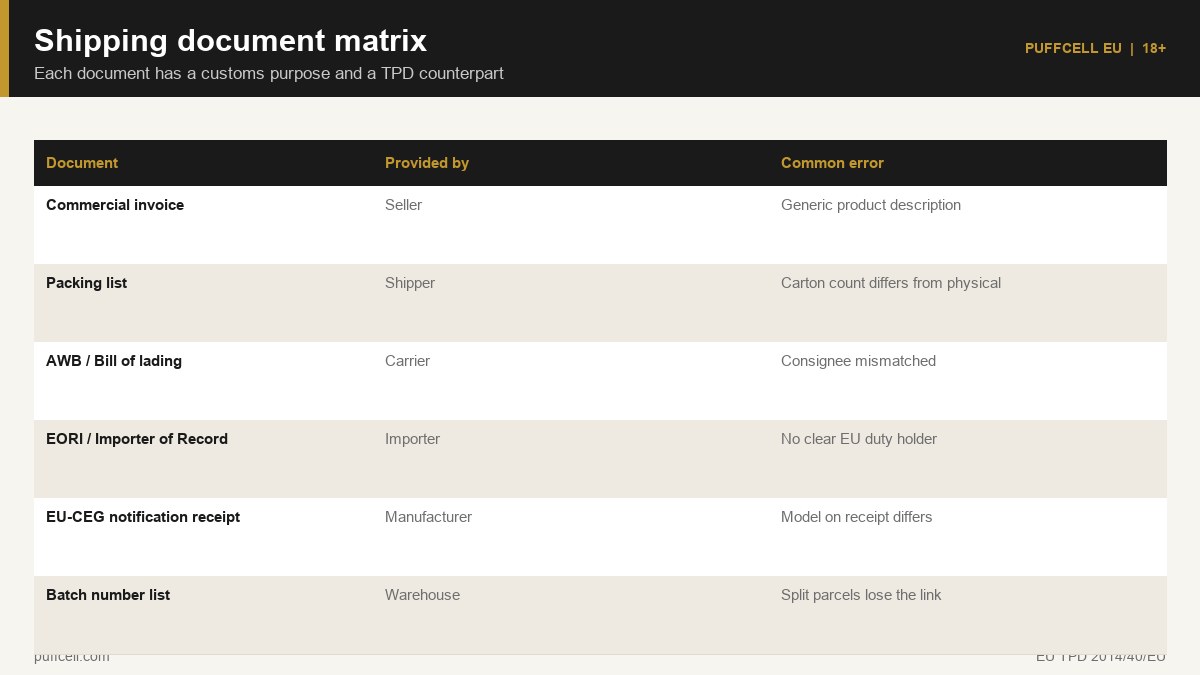
Each of those fields reappears in the matrix below, and each one is a place where a mismatch can hold the goods.
2. The customs document matrix: nine documents, eight checks
Nine documents do the work. The table maps who issues each one, what customs or a later recall uses it for, how it ties back to the TPD file, and the error that most often appears on it. Keep it as a working sheet for every consignment.
| Document | Issued by | Customs or traceability purpose | Link to the TPD file | Common error |
|---|---|---|---|---|
| Commercial invoice | Exporter or seller | Declares customs value, quantity and model string for the entry | Model string must equal the EU-CEG notification receipt | Generic description such as “vape device” instead of the notified model |
| Packing list | Exporter or warehouse | Reconciles cartons, weights and lot numbers against the physical load | Lot numbers tie to the batch register used for Article 20(9) corrective action | Lot codes omitted, so the carton cannot be traced to a production batch |
| AWB / Bill of Lading | Carrier or freight forwarder | Identifies the consignment and links it to the invoice and entry | Consignment reference stored with the notification receipt | AWB number not cross-referenced, breaking the audit trail at the border |
| EORI number and Importer of Record declaration | Importer or its broker | Identifies the party lodging the declaration and liable for duties | Names the importer that owes the Article 20(2) notification | EORI of the forwarder used while the Importer of Record is a different entity |
| Origin and tariff classification statement | Exporter with the broker | Supports the declared heading, origin and any preference claim | Confirms the classified product is the notified product | Heading 8543.70 applied without confirming the actual subheading with the competent customs authority |
| EU-CEG notification receipt | Notifying manufacturer or importer | Evidences the six-month Article 20(2) submission when surveillance asks | The primary TPD artefact; carries the submission ID and notified model list | Receipt for a superseded formulation while a newer model is shipped |
| Product label specimen / artwork | Manufacturer | Lets the border compare physical labelling with the notified file | Must show ingredient list, nicotine content and the Article 20 leaflet and health warning | Labelling only in one language where the destination Member State requires local languages |
| Batch number list / lot manifest | Warehouse or exporter | Maps every dispatched lot to a customer and a carton range | Feeds the inbound record used for a 24-hour recall trace | Single master lot with no breakdown, so a partial recall cannot be scoped |
The last three rows are the ones wholesalers most often skip, because none of them is needed to calculate a duty. All three are needed the moment a competent authority asks which customers received a given lot.
3. Importer of Record and the EU-based responsible person are not the same party
The Importer of Record is the entity that lodges the customs declaration, pays the duty and, under Article 20 of the TPD as described by the European Commission, carries the importer’s notification duty. An EU-based responsible person or authorised representative is a separate arrangement: a party established in a Member State that a manufacturer appoints to hold documentation and liaise with authorities. The two can be the same company, but they are distinct legal roles, and a consignment can clear customs with one while the TPD file names the other. When a wholesale buyer signs a supply agreement, the contract has to say which party is the importer for Article 20(2), because the six-month clock runs from the notifier, not from the carrier. If the exporter notifies in its own name and the buyer also imports under its own EORI, both may need a notification, or the file may name nobody the authority can reach.
Clauses to put in the supply agreement
- Name the Importer of Record by legal entity and EORI, and state who files the Article 20(2) notification in EU-CEG.
- Attach the EU-CEG submission ID and receipt date, and require six months between notification and first dispatch of that model.
- State who holds the annual Article 20(7) sales and consumer-preference data and who answers an Article 20(9) adverse-effect request.
- Require the model string on invoices to match the notified model string, with a written change procedure for any rename.
The supplier due diligence checklist covers how to confirm the notifier’s identity before these clauses are signed; compliance basics for wholesale businesses sets out where the importer duty sits alongside the rest of the TPD obligations.
4. A batch record that survives a recall
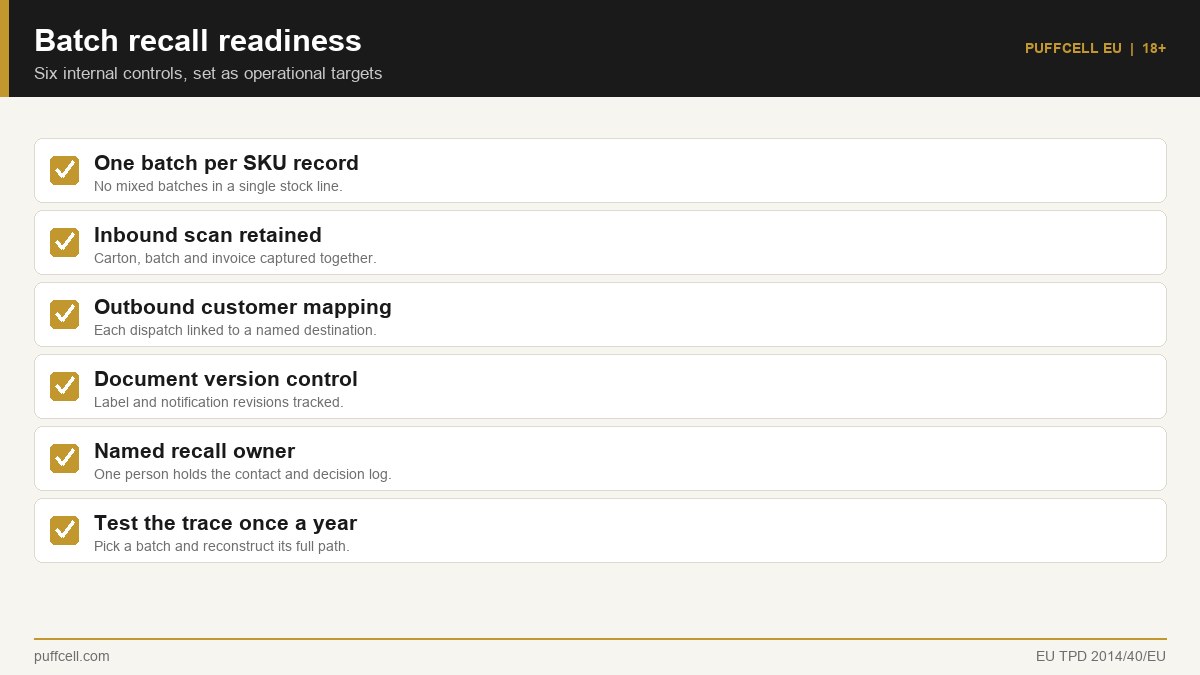
Traceability is a filing discipline, not a software purchase. The goal is that any single lot can be traced from the production batch to the customer invoice without guessing. Build the register before the first pallet arrives.
- Fix a batch number rule: a model code, a production date in YYYYMMDD and a sequential lot, printed on the carton and repeated on the packing list.
- At inbound, log the batch number, carton range, quantity, arrival date, AWB number and the EU-CEG submission ID linked to that model.
- Store one line per carton, not one line per consignment, so a partial recall can be scoped.
- At outbound, map each dispatched batch number to the customer invoice number, dispatch date and carrier consignment note.
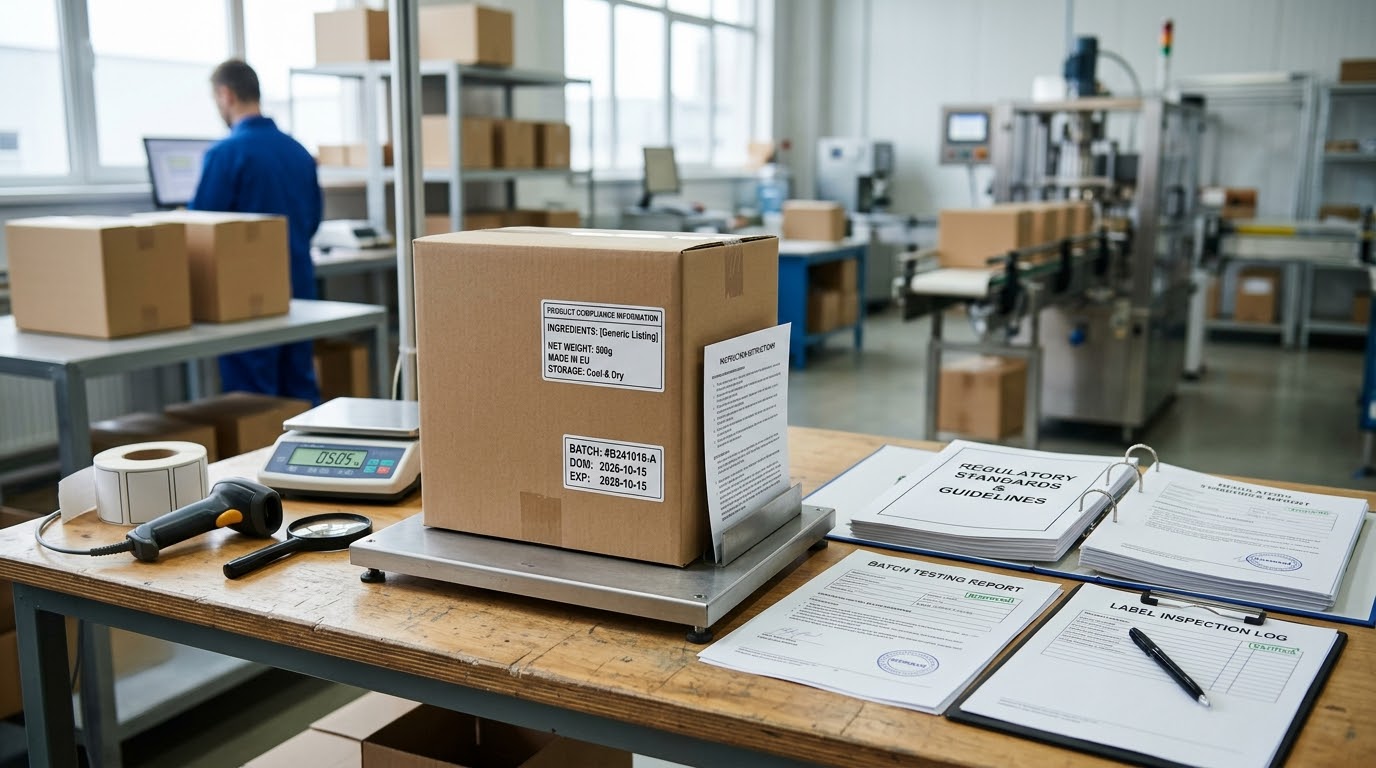
- Reconcile the physical carton labels against the packing list at goods-in; flag and quarantine any carton whose code is missing.
- Retain the label specimen and the notification receipt beside the batch register so a surveillance request is answered from one file.
Locating a lot inside a 24-hour internal target
Set a 24-hour internal target for a full trace, from a lot number to the list of customers who received it; this is an internal service target, not a statutory deadline, and no law fixes a number of hours here. Article 20(9) requires information on suspected adverse effects to be collected and corrective measures taken, and Article 20(7) requires annual sales and consumer-preference data, so the register built for a recall also feeds both duties. Run a drill once a quarter: pick a batch number at random, pull the inbound line, the outbound customer map and the EU-CEG receipt, and time how long it takes.
5. Five recurring failure points and the control for each
The same five problems account for most paperwork holds. The table gives the symptom customs or a recall team sees and the control that prevents it.
| Failure point | What the reviewer sees | Preventive control |
|---|---|---|
| Model does not match the notification receipt | Invoice model string differs by a suffix from the EU-CEG model list | Lock the model string in a controlled list; any rename goes through a new notification before dispatch |
| Invoice product name too generic | “Electronic cigarette” with no model, quantity per model or lot reference | Require one invoice line per notified model with its exact model string and quantity |
| Labelling language mismatch | Carton artwork carries one language where the destination Member State requires its own | Approve a label specimen per destination market and attach it to the consignment file |
| Documents and physical batch numbers disagree | Packing list lot codes absent from the cartons, or vice versa | Reconcile carton labels against the packing list at goods-in and quarantine exceptions |
| Split parcels break the trail | One master lot divided across several AWBs with no per-parcel lot map | Issue a packing list and lot map for every parcel and keep a master manifest tying all AWBs to one batch |
Four of the five are prevented before the goods leave the warehouse. The fifth is prevented at the booking stage, when the forwarder decides how many AWBs a single order will be split across.
6. Product data the border file has to carry
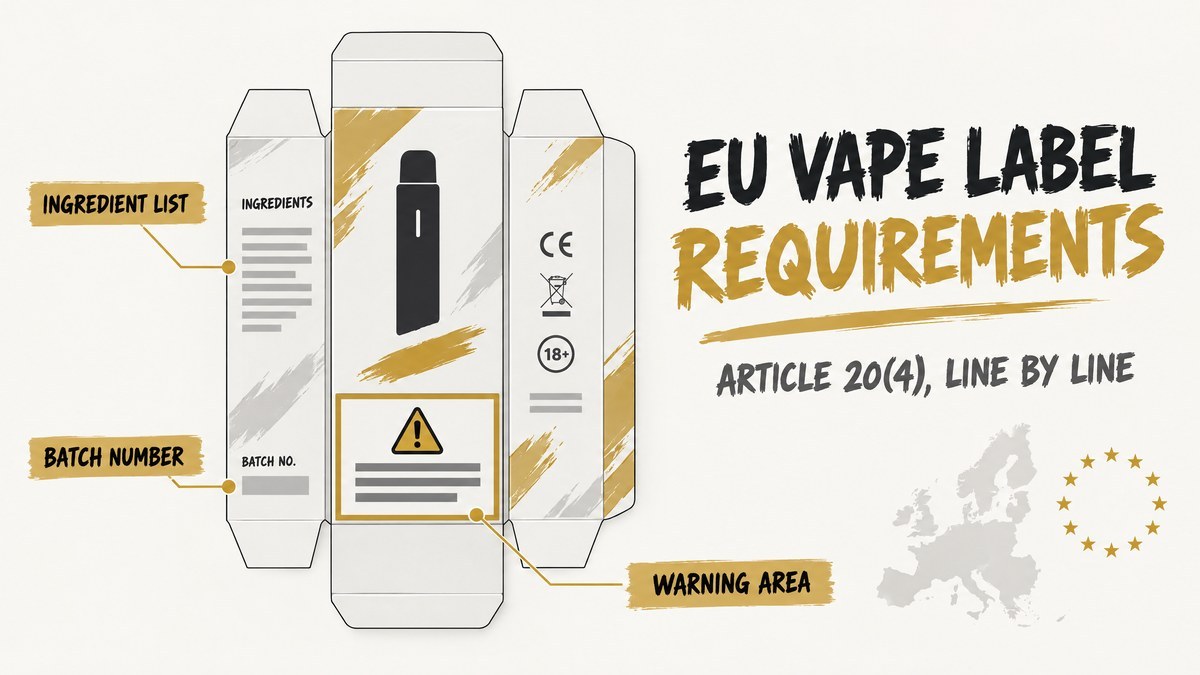
Three numbers travel with every consignment and none of them is a shipping number. Article 20(3)(b) caps nicotine-containing liquid at 20 mg/ml (2%); Article 20(3)(a) caps tanks and cartridges at 2 ml and refill containers at 10 ml; and the products are for 18+ adults, with age verification applied at the point of sale. These are labelling and classification facts, so the label specimen in the consignment file has to show the ingredient list, the nicotine content as 2%, the leaflet and the health warning, with no promotional element. Member States may add local-language labelling and notification fees, so artwork approved for one destination is not automatically valid for another; confirm the current requirements with the competent authority in the Member State of import.
Cross-check the model identifier while the file is open. Take one SKU, for example the Bang Blaze 140K 3-in-1: the model string printed on the carton, the model string on the commercial invoice and the model string in the EU-CEG notification receipt have to be identical, character for character. A rename at the marketing stage that never reaches the notified model list is the single most common reason a compliant product is held on a paperwork discrepancy. Once the consignment is cleared, the retailer product documentation checklist sets out which of these documents your buyer will ask for at the next handover; the batch register and the label specimen are the two that most often go missing.
FAQ
Which document proves a vape model was notified under the TPD?
The EU-CEG notification receipt, carrying the submission ID and the notified model list, is the evidence. Article 20(2) of Directive 2014/40/EU requires the manufacturer or importer to notify the competent authority of each Member State six months before placing a product on the market, using the common format set by Commission Implementing Decision (EU) 2015/2183. Keep that receipt in the consignment file and match its model string to the commercial invoice.
Is an EORI number the same as being the Importer of Record?
No. An EORI number is the identification code a customs declaration is lodged under, while the Importer of Record is the legal entity liable for the declaration and the duty, and the party that owes the Article 20(2) notification when it imports. A customs broker’s EORI can appear on the entry while a different company is the importer. An EU-based responsible person is a third, separate role, so name all three in the supply agreement.
What nicotine and age data must the border file show?
Article 20(3)(b) caps nicotine-containing liquid at 20 mg/ml (2%), and the figure used on documentation is 2%. The products are for 18+ adults, with age verification at the point of sale. The label specimen in the consignment file has to show the ingredient list, nicotine content, the leaflet and the health warning. Article 20(3)(a) separately caps tanks and cartridges at 2 ml and refill containers at 10 ml.
Can one consignment be split across several parcels?
It can, but each parcel needs its own packing list, its own AWB or consignment note and its own map of batch numbers to cartons. Traceability breaks when a single master lot is divided across several AWBs without a per-parcel lot map, because a recall can then no longer be scoped to the customers who received a specific lot. Keep a master manifest that ties every AWB back to one batch register entry.
How quickly must a batch be traced during a recall?
No statutory deadline fixes a number of hours for an internal trace, so set a 24-hour internal target from lot number to the list of customers who received it. Article 20(9) requires information on suspected adverse effects to be collected and corrective measures taken, and Article 20(7) requires annual sales and consumer-preference data. The batch register built for the recall target also supplies both of those duties.
Which tariff heading covers imported e-cigarettes?
E-cigarettes are often entered under tariff heading 8543.70 and related subheadings, but the actual classification must be confirmed with your customs broker or the competent customs authority before the goods are declared, and no fixed rate is assumed here. The origin and classification statement in the consignment file should record the confirmed subheading and tie it to the notified model string, so the declared product and the EU-CEG product are the same one.
Next steps
Bring the document matrix into your next booking: reconcile the model string, the Importer of Record and the lot numbers before the container is sealed, and run one 24-hour recall drill on a live batch. Talk to the PuffCell team about your consignment documentation to align the invoice, packing list and EU-CEG receipt before dispatch.
Last reviewed: 5 November 2026
Shop the range
Looking for the devices these guides are about? These models are currently in stock and ship from our EU warehouse.