EU Vape Wholesale Supplier Due Diligence
A purchase order for 40,000 units sits on your desk and the supplier has sent a one-page “certificate of compliance” instead of a notification receipt. Six weeks later a member state competent authority asks for the Article 20(2) submission behind that SKU, and nobody can produce it. Wholesale files fail this way: not because the device is unlawful, but because the buyer never obtained the paper trail proving it was notified six months before sale. Vetting an e-cigarette supplier in the EU is a document exercise with a six-month clock, recorded in EU-CEG. Below: the file to open before signing, the questions for a compliance contact, and the four gates that keep it current.
The six-month clock behind every supplier file
Article 20 of Directive 2014/40/EU governs electronic cigarettes and refill containers. It entered into force on 19 May 2014 and applied in member states from 20 May 2016. Article 20(2) requires manufacturers and importers to notify each member state’s authority six months before placement, through EU-CEG under Commission Implementing Decision (EU) 2015/2183. The Commission’s implementing measures set the technical rules.
The duty to file is not yours; holding the evidence is. Before the first order the file needs the notifying entity, member state, submission date and EU-CEG acknowledgement. Set that date against the earliest invoice: under six months is a rejection. The wider framework is in the EU vape wholesale compliance guide.
What the Article 20(2) dossier contains
Article 20(2) is not one certificate: the dossier carries ingredients, emissions, toxicological data, nicotine dose and uptake, a device description and a production process. Ask for the index under one submission ID; the Commission’s electronic cigarettes page sets the scope.
The document request checklist
Eight documents, requested as one package with a deadline attached to the order. Each row names the issuer, the confirming step and the exposure if it never arrives. The retailer-facing companion is the product documentation retailer checklist.
| Document | Issued by | How to verify it | Risk if missing |
|---|---|---|---|
| EU-CEG acknowledgement | Member state authority via EU-CEG | Match ID and SKU; date six months before sale | No Article 20(2) proof |
| Article 20(2) dossier | Manufacturer or importer | One ID indexes ingredients, emissions, toxicology, dose, device, process | Cannot answer an authority enquiry |
| Ingredient and emissions reports | Accredited lab, report number | Tie to batch code, formulation, coil, current date | 20 mg/ml (2%) ceiling unevidenced |
| Toxicological dataset | Manufacturer or toxicologist | Dataset cited inside the Article 20(2) submission | No defence in an enquiry |
| EU economic operator details | Supplier’s legal entity | Registered name, member-state address, number; match notifying entity | Nobody answerable under Article 20 |
| Labelling and leaflet proofs | Manufacturer or importer | Ingredient list, 2% declaration, health warning, full instructions | Repackaging cost, delayed sell-in |
| Annual sales data record | Manufacturer/importer, kept by wholesaler | Prior Article 20(7) reference; reconcile with purchase ledger | No traceable volume in an enquiry |
| Adverse-effects and recall procedure | Supplier’s quality system | Written Article 20(9) procedure, named contact, worked example | Stock cannot be quarantined |
Log three fields the moment the package lands:
- The EU-CEG submission ID and exact product identifier string.
- The name, member-state address and registration number of the notifying entity.
- The receipt date of each document plus the approval-sheet signatory.
Red flags and the follow-up each one triggers
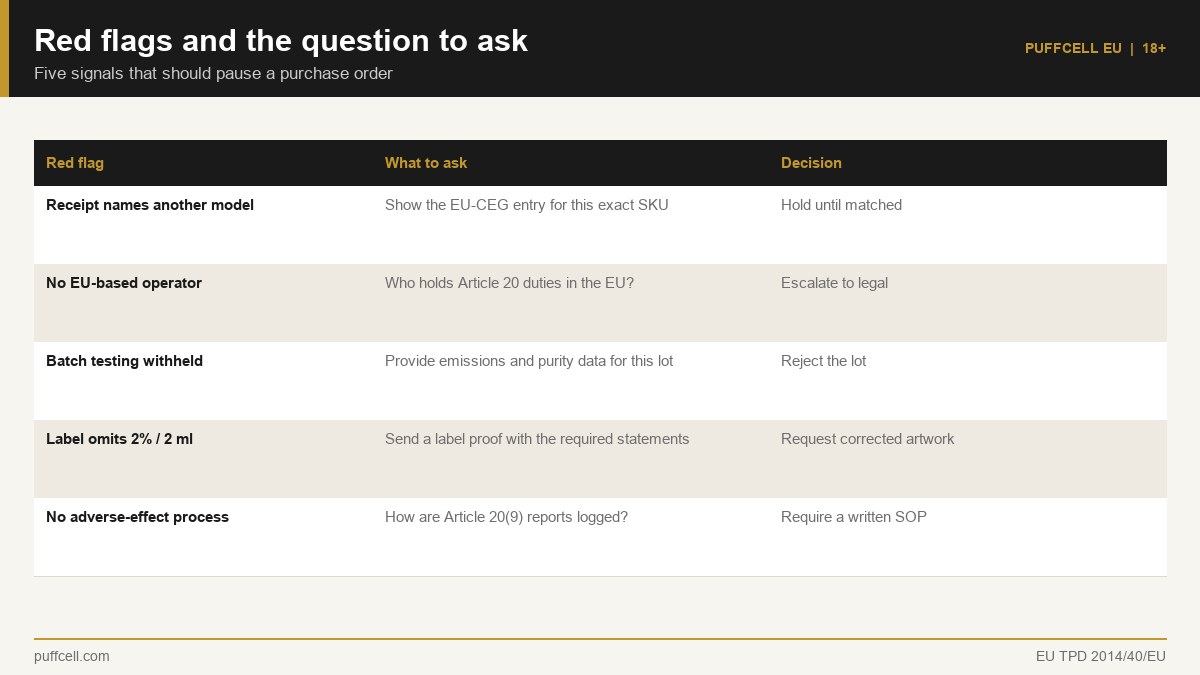
A file rarely announces its own weakness. Each defect below is a mismatch you can photograph and file; each follow-up closes the gap or stops the order.
| Red flag | What it points to | Follow-up action |
|---|---|---|
| Receipt identifier does not match the ordered SKU | A sibling product’s filing reused | Suspend order; demand the full EU-CEG ID and identifier field |
| Responsible person has no member-state address | No EU-established importer behind the filing | Ask for registration certificate; match to notification before release |
| Generic certificate, no batch test reports | Untested formulation, no evidence behind 2% | Require lab, report number, batch code; reject if unlinked |
| No 20 mg/ml (2%) or 2 ml / 10 ml statement | Article 20(3) limits absent from pack | Hold order; request corrected proofs with local-language warning |
| Leaflet omits risk groups or adverse reactions | Incomplete instructions under Article 20 | Request full text; tick off usage, reactions, groups, addictiveness, toxicity |
| “Fully compliant, nothing further to check” is the reply | No document trail | Put the ten questions in writing; require dated answers |
| No prior-year data or corrective-action example | Article 20(7) and (9) unmet | Ask for the last submission reference and one worked example |
Ten questions for the supplier’s compliance contact
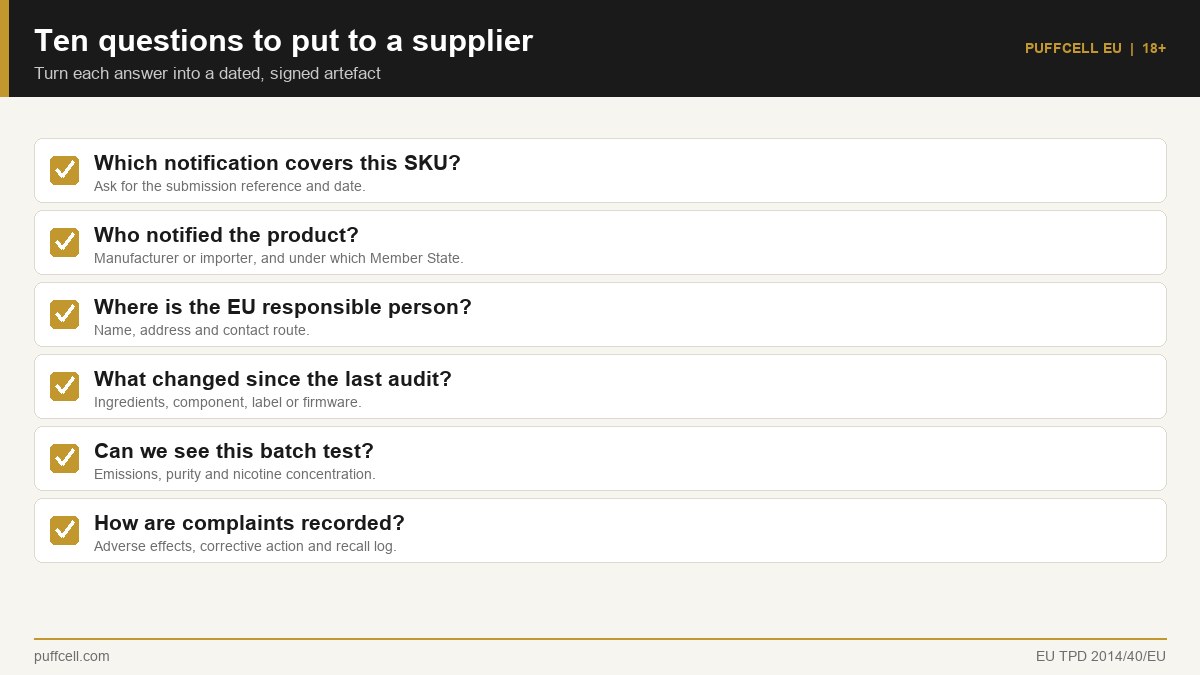
Send these as a numbered questionnaire; require written, dated replies. A phone call produces an assurance, a written answer a record for the approval sheet.
- Which legal entity filed the Article 20(2) notification for this SKU, and on what EU-CEG submission date?
- Give the EU-CEG submission ID and product identifier field — does it match our purchase-order SKU exactly?
- In which member state is the economic operator established, and what is its registration number?
- Which accredited laboratory produced the emissions and ingredient reports for this batch, and what is the report number?
- What nicotine concentration is declared, and where does the 20 mg/ml (2%) figure appear on the pack and dossier?
- What are the tank or cartridge and refill volumes, and how do they sit against the 2 ml and 10 ml ceilings?
- Send the leaflet text — does it name risk groups, adverse reactions, addictiveness and toxicity in the local language?
- What is your written Article 20(9) procedure, and who is the named contact who would reach our warehouse?
- Provide the Article 20(7) submission reference for the last reporting year and the volume filed for this line.
- If you reformulate or change the coil, what triggers a fresh notification, and how are we told before changed stock is released?
Reading the label and leaflet as evidence
The label is the cheapest audit tool in the file: the one piece of evidence held against the light at goods-in. Products here are for 18+ adults. The compliance basics for EU wholesale businesses page covers the wider obligations.
Nicotine and volume ceilings on the pack
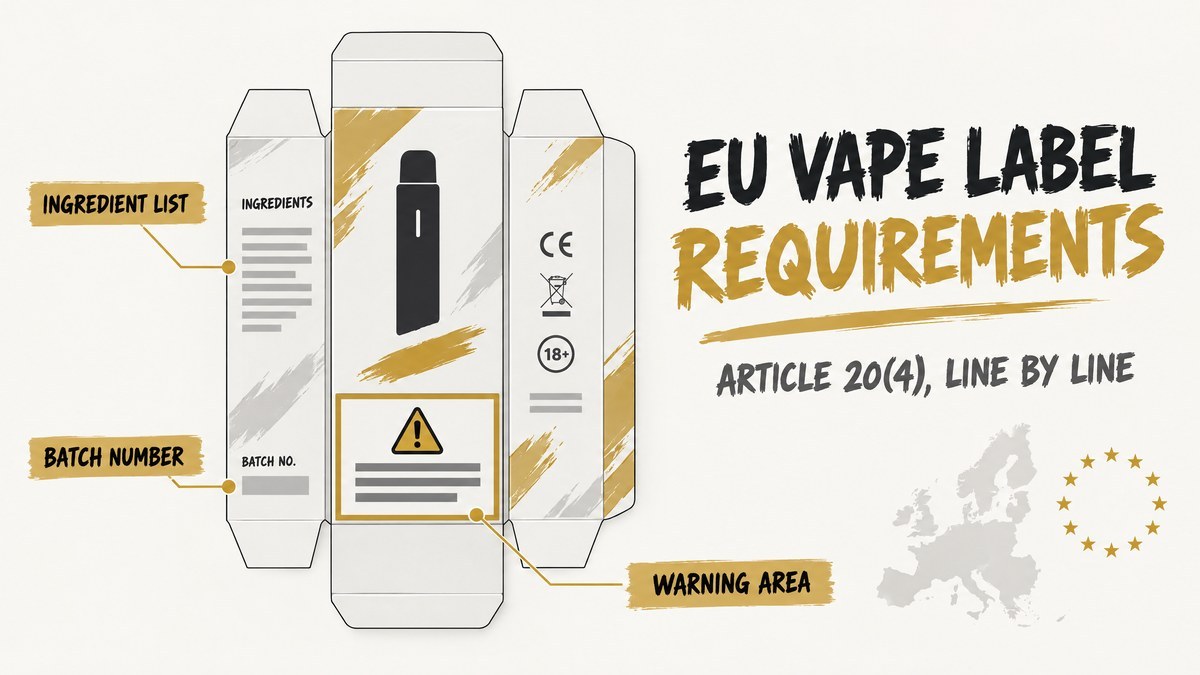
Article 20(3)(b) caps nicotine-containing liquid at 20 mg/ml (2%); Article 20(3)(a) caps tanks and cartridges at 2 ml and refill containers at 10 ml. Your wording carries 2%; 20 mg/ml (2%) belongs where the regulation is cited. Confirm the ingredient list, nicotine content and health warning, with no promotional element — Article 20 bans promotional packaging and cross-border advertising. Commission Implementing Decision (EU) 2016/586 adds child-resistant, tamper-evident and leak-free refill rules; ask which drawing covers it.
Age and risk-group wording
Instructions for use cover usage, adverse reactions, risk groups, addictiveness and toxicity; a risk group is required wording, not a marketing segment. Add a device such as the Bang Blaze 140K 3-in-1 to an order and treat the model name as an identifier, not a specification: the EU-CEG acknowledgement, label proof and carton marking must match. Member states may add local-language labelling, flavour restrictions, excise duty and 18+ age verification, so confirm current requirements with the member state competent authority.
Audit cadence and the records a wholesaler retains
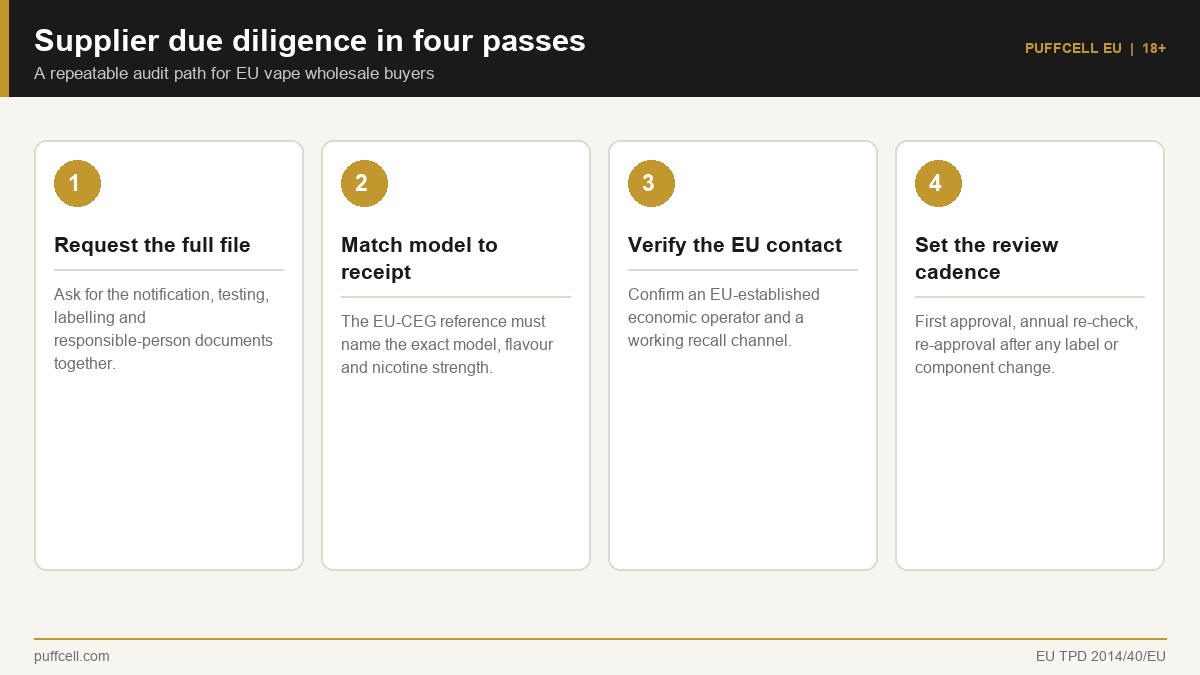
A file approved once decays. Build four gates into the procurement SOP, each producing a named artefact an auditor can request by filename. Align the second with the Article 20(7) cycle and tie the fourth to every delivery.
Four gates, four artefacts
- Initial onboarding, before the first order: signed approval sheet, eight documents ticked, EU-CEG ID, notifying entity, date, approver.
- Annual re-assessment: refreshed file with prior Article 20(7) reference, renewed reports, ledger reconciliation, fresh signature.
- Change control, before changed stock is released: change note with old and new SKUs, trigger, fresh Article 20(2) date, accept-or-re-tender decision.
- Batch arrival sampling: goods-in record with batch code, quantity, label-proof photograph, leaflet tick-off, pass or hold decision.
At the fourth gate, customs traceability records meet the compliance file: the carton batch code must resolve back to an approved sheet or the delivery goes on hold. A wholesaler is not the manufacturer and does not file Article 20(2), yet it retains obligations an authority can test — hold the acknowledgement, label and leaflet proofs, goods-in records, reconcile Article 20(7) volumes and keep the Article 20(9) route open. A distributor without that receipt when a competent authority traces a SKU backwards has no document to stand on.
FAQ
Who legally files the Article 20(2) notification — the manufacturer, the importer or my wholesale business?
Manufacturers and importers file it six months before a product is placed on a member state market, through EU-CEG under Commission Implementing Decision (EU) 2015/2183. Directive 2014/40/EU entered into force on 19 May 2014 and applied from 20 May 2016. Your wholesale business does not submit, but holds the acknowledgement, names the notifying entity and keeps the submission date in the supplier file.
How far ahead of a launch must the notification be submitted?
Article 20(2) sets six months before the product is placed on the market. Take the submission date from the EU-CEG acknowledgement and set it against the earliest invoice for that SKU; a shorter interval is a file rejection. Assume no approval duration beyond this lead time — where a market adds steps, confirm current requirements with the member state competent authority rather than accepting a supplier’s estimate.
What nicotine strength and volumes does the TPD actually allow?
Article 20(3)(b) caps nicotine-containing liquid at 20 mg/ml (2%). Article 20(3)(a) caps tanks and cartridges at 2 ml and refill containers at 10 ml. These products are for 18+ adults. Member states may add flavour restrictions, excise duty, local-language labelling and age verification, so a dossier for one member state does not automatically cover another.
What does Article 20(7) require each year, and why does a wholesaler care?
Article 20(7) requires an annual submission of sales volumes and consumer-preference information from manufacturers and importers. A wholesaler reconciles its purchase ledger against the filed figure: a persistent mismatch points to an undocumented line or to stock outside the approved file. Keep the prior year’s submission reference and filed volume as dated fields in the supplier-approval sheet.
What counts as an adverse-effect record under Article 20(9)?
Article 20(9) requires collecting information on suspected adverse effects and taking corrective measures. Ask for the written procedure, a named contact and one worked corrective-action example that reached a warehouse. A glossy certificate is not a record. Confirm the route reaches your own goods-in team so stock can be quarantined; a procedure without a contact and an example has never been exercised.
Which labelling failures should stop a purchase order immediately?
Hold the order for a missing ingredient list, no 2% declaration, no health warning, or a leaflet lacking usage, adverse reactions, risk groups, addictiveness and toxicity. Article 20 labelling rules also ban promotional elements and cross-border advertising. Commission Implementing Decision (EU) 2016/586 adds child-resistant, tamper-evident and leak-free refill requirements; request the drawing covering that mechanism before accepting corrected proofs.
Next steps
Put the eight-document checklist into your next supplier file before any purchase order is released, and date the approval sheet. To have a product line measured against it, contact the PuffCell EU team with the SKU and EU-CEG submission ID, and we will identify which documents are outstanding.
Last reviewed: 5 November 2026
Shop the range
Looking for the devices these guides are about? These models are currently in stock and ship from our EU warehouse.