EU Vape Product Documentation for Retailers
At 09:40 on a Tuesday a trading standards officer asks for the EU-CEG notification receipt behind a device on the shelf. The manager has the invoice, the delivery note and a photo of the box — not the submission that Directive 2014/40/EU, Article 20(2), demands six months before the unit reached the market. An invoice proves a purchase, not a notification. Below is the per-SKU folder: what exists, who signs it, when it is needed, how long it stays, and what goods-in matches against the pack — for 18+ retail, where the same file answers customer questions and inspection visits.
Why a retailer holds a file rather than a single certificate
Article 20 of the Tobacco Products Directive puts the notification duty on the manufacturer or importer, not the shop. Six months before a product is placed on the market, that company submits a dossier to each Member State’s competent authority in the EU-CEG common format, set by Commission Implementing Decision (EU) 2015/2183. The Directive entered into force on 19 May 2014 and applied from 20 May 2016. The dossier names ingredients, emissions, toxicological data, nicotine dose and uptake, and the device and production process. The authority returns a submission receipt; no licence is issued.
No single document covers a shelf: a wholesale order brings a stack of supplier papers to organise, keep current and retrieve. The EU vape wholesale compliance guide maps the wider duties, the compliance basics for wholesale businesses page sets out Article 20, and the Commission’s electronic cigarettes page summarises the rules.
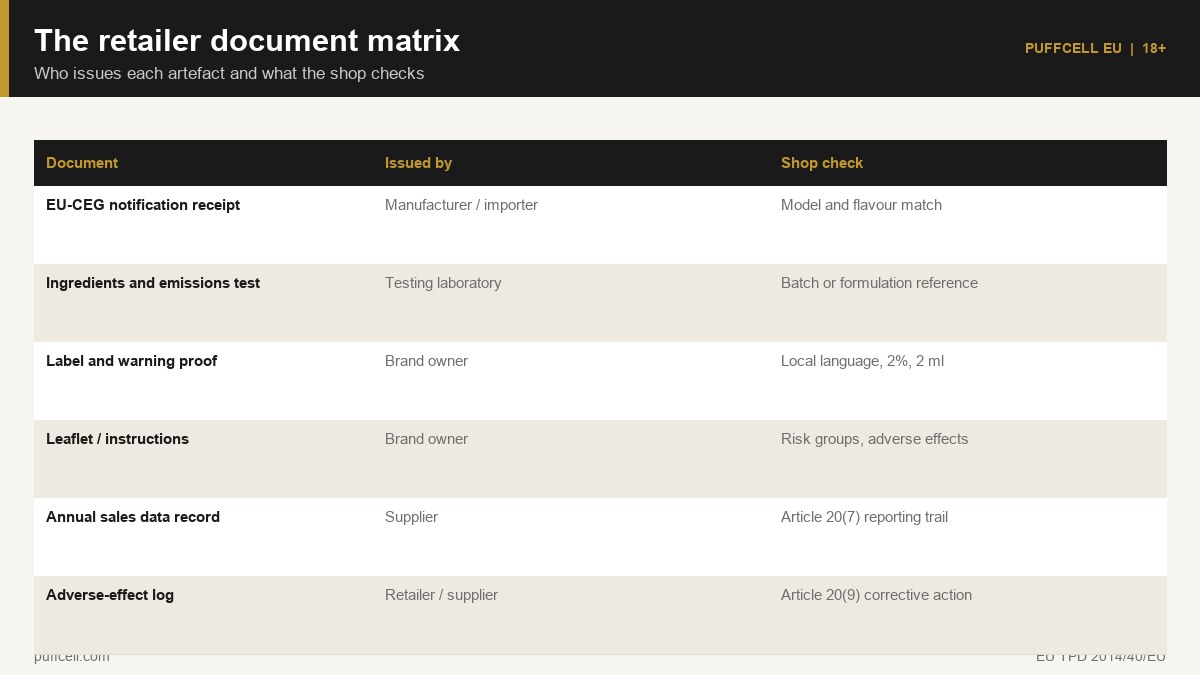
The retailer document matrix
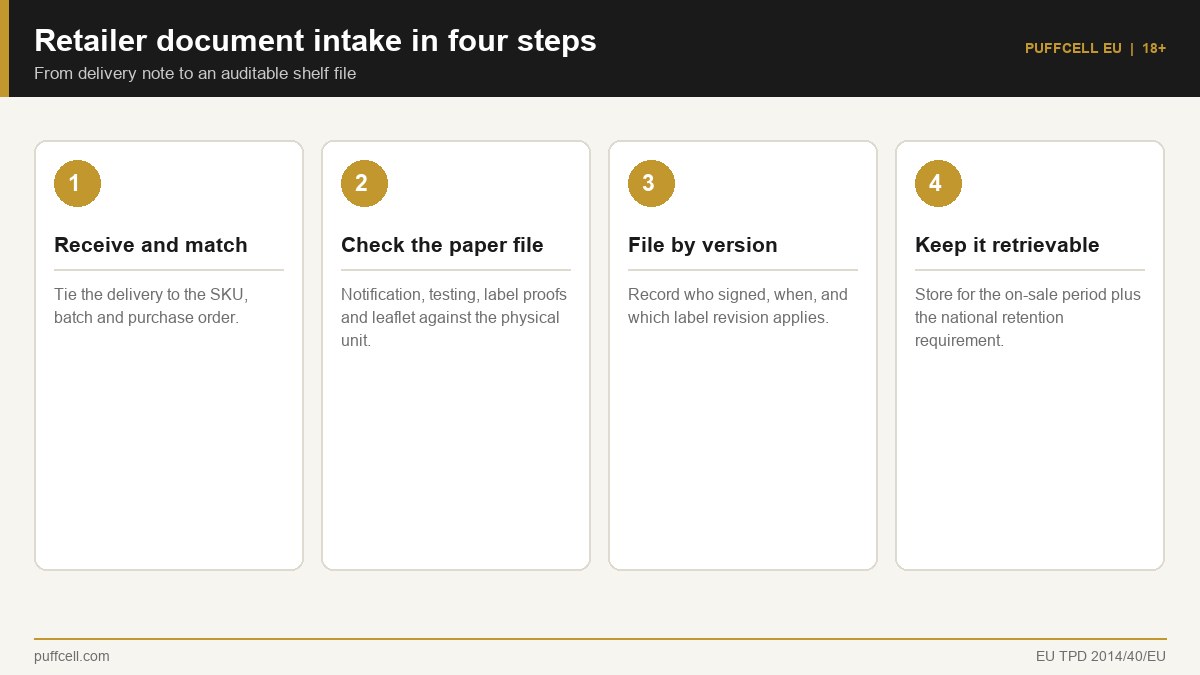
Eight records sit behind a compliant SKU. Where no harmonised EU figure fixes retention, the rule is the on-sale period plus the national post-delisting requirement; ask the competent authority for the current rule rather than inventing a number of years.
| Document / record | Issued by | When needed | Retention or refresh | Store acceptance point |
|---|---|---|---|---|
| EU-CEG notification receipt | Competent authority, to the importer | Before first sale; Article 20(2), six months ahead | On-sale period plus national post-delisting retention | Submission ID, date and product name match the SKU |
| Article 20(2) dossier: ingredient and emissions reports, toxicological data | Manufacturer or importer, with the laboratory | At notification and for each new variant | Refresh on formulation change; on-sale period plus retention | 2% nicotine (20 mg/ml (2%), Article 20(3)(b)); report dates precede submission |
| Declaration of conformity or equivalent signed statement | Manufacturer or importer, signed | First delivery, and after any design change | Re-issue on redesign; on-sale period plus retention | Cites Decision (EU) 2016/586; signature and date present |
| Label artwork proofs, including the printed health warning | Brand owner or importer | Before each print run and each language version | Re-approve on label change; on-sale period plus retention | Ingredient list, 2%, health warning, no promotion; language fits |
| Instructions for use leaflet | Manufacturer or importer | Inside every retail unit at point of sale | Re-issue on device or text change; on-sale period plus retention | Use, adverse reactions, risk groups, addictiveness, toxicity; local language |
| Annual sales data, consumer preferences (Article 20(7)) | Importer compiles; retailer supplies figures | Every year | One filing per year; keep the sales extract | Volumes by SKU reconcile with till records |
| Adverse effects log, corrective actions (Article 20(9)) | Retailer records; importer reports on | From the first unit sold | Date and outcome logged; on-sale period plus retention | Complaint links to a batch; names the corrective action |
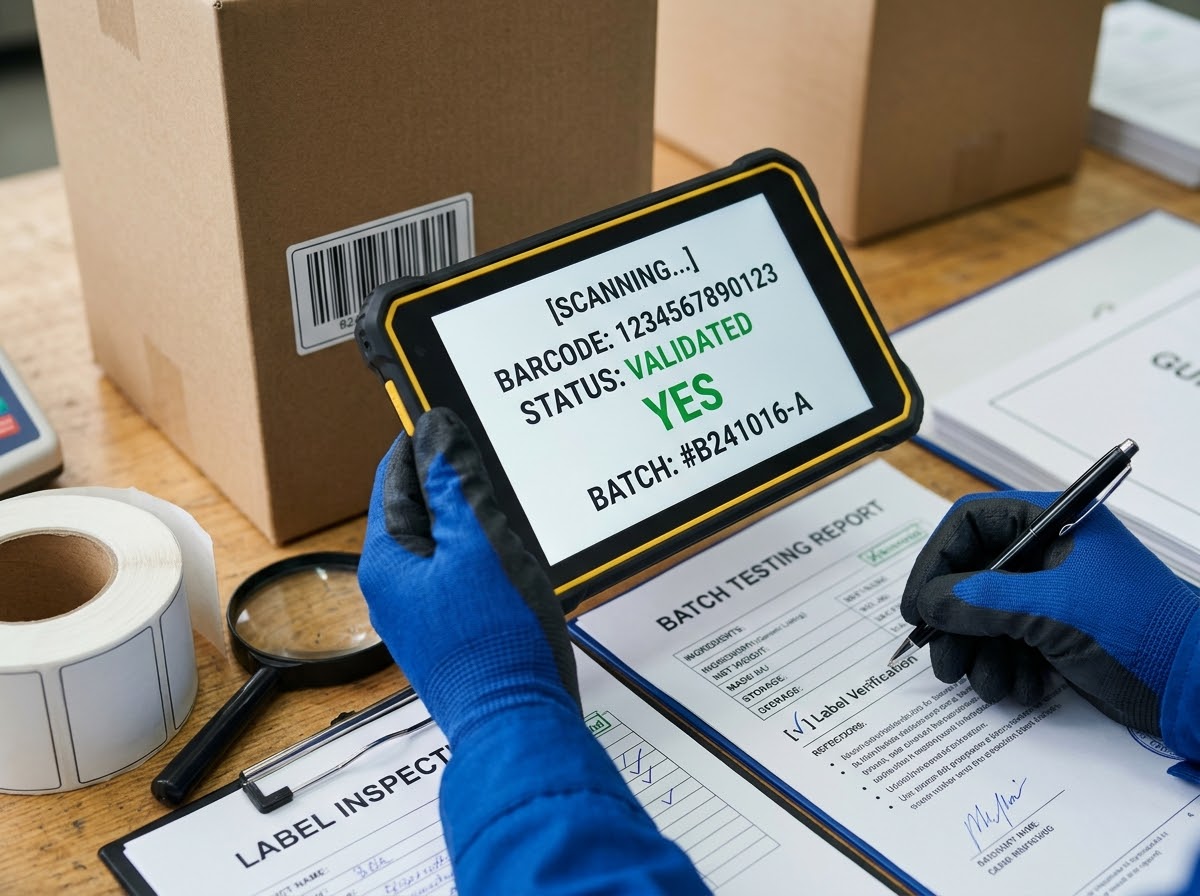
| Batch and traceability records | Supplier and retailer together | At goods-in and at every sale | On-sale period plus national post-delisting retention | Batch code agrees on carton, box and unit |
The EU-CEG receipt proves a six-month-ahead notification; a supplier’s “certificate of compliance” cannot replace it. Article 20(7) and Article 20(9) rows are living records the retailer helps create. The Commission’s implementing measures for Directive 2014/40/EU list 2015/2183 and 2016/586.
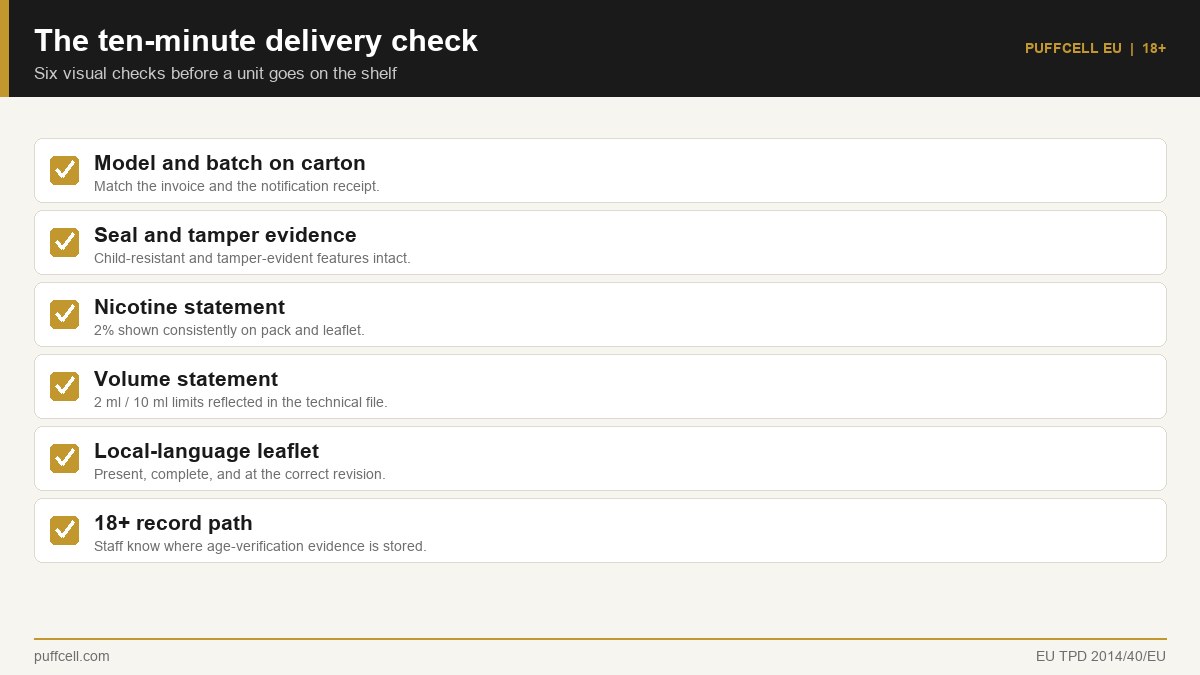
A 10-minute goods-in inspection, carton to single unit
Run this timed sequence before the carton is broken down; a failed step sends the lot to quarantine with a note on the goods-in sheet.
Outer carton, minutes 0–3
- Match the delivery note to the carton: model, SKU, quantity before cutting the tape.
- Record the carton batch number, the traceability key.
- Note any broken seal or re-taped edge, photograph it, set the carton aside.
Retail box, minutes 3–7
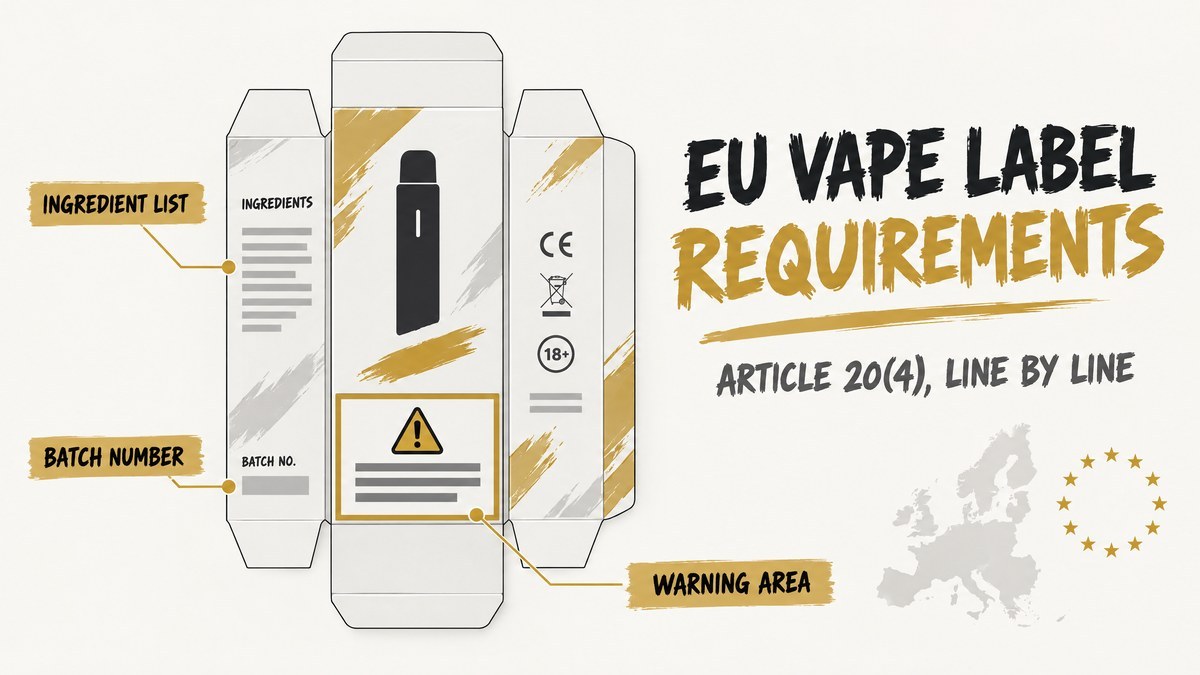
- Match the model and flavour name to the approved label artwork proof.
- Find the nicotine figure: 2%, against the Article 20(3)(b) ceiling of 20 mg/ml (2%).
- Capacity wording cites the Article 20(3)(a) limits — 2 ml for tanks and cartridges, 10 ml for refill containers — not an invented fill figure.
- Read the health warning and ingredient list; no promotional element or cross-border advertising.
Single unit, minutes 7–10
- Confirm a local-language leaflet: use, adverse reactions, risk groups, addictiveness, toxicity.
- Inspect the tamper-evident, child-resistant closure per Commission Implementing Decision (EU) 2016/586.
- Match the unit batch code to carton and note; three mismatches keep the lot off the shelf.
- Stamp the goods-in sheet with date, SKU, batch and signatory.
Version control when a model, flavour or label changes
A revised flavour or reprinted label is a new documentation event. Under Article 20(2) a new or substantially modified product needs its own notification six months before its market date, so the EU-CEG receipt changes. Close the old SKU file and open a new version.
What must be re-issued
- A fresh EU-CEG receipt dated six months before the new market date.
- Updated ingredient, emissions and toxicological data if the formulation changed.
- Re-approved label proofs with the health warning in each local language.
- A reprinted leaflet if the device, flavour range or warning text changed.
- A re-signed declaration of conformity from the manufacturer or importer.
- A revised batch-record template with the new SKU and version number.
The importer’s quality signatory signs the re-issued declaration and proofs; the retailer’s goods-in signatory signs only the acceptance sheet. Name each file SKU_flavour_market_doc-type_vN_YYYY-MM-DD, keep one versioned file per market, and put a one-page index at the front listing current and superseded versions. Never overwrite an older proof: an officer asking about a unit sold in March needs the March artwork. Keep superseded versions for their on-sale period plus the national rule.
Customer questions and inspection visits: what leaves the folder
A customer asking what is in a device gets the ingredient list and the 2% nicotine figure from the pack, plus the leaflet; one asking whether it was notified gets the EU-CEG receipt reference, not a marketing claim. Log a suspected adverse effect question: Article 20(9) turns a complaint into a dated record with a corrective action.
What to hand over during a trading standards visit
- The EU-CEG receipt and Article 20(2) dossier reference for the SKU.
- The signed declaration of conformity naming Commission Implementing Decision (EU) 2016/586.
- The approved label proof and the local-language leaflet.
- The batch and traceability record linking the unit to its delivery note.
- The Article 20(9) adverse effects log with corrective actions.
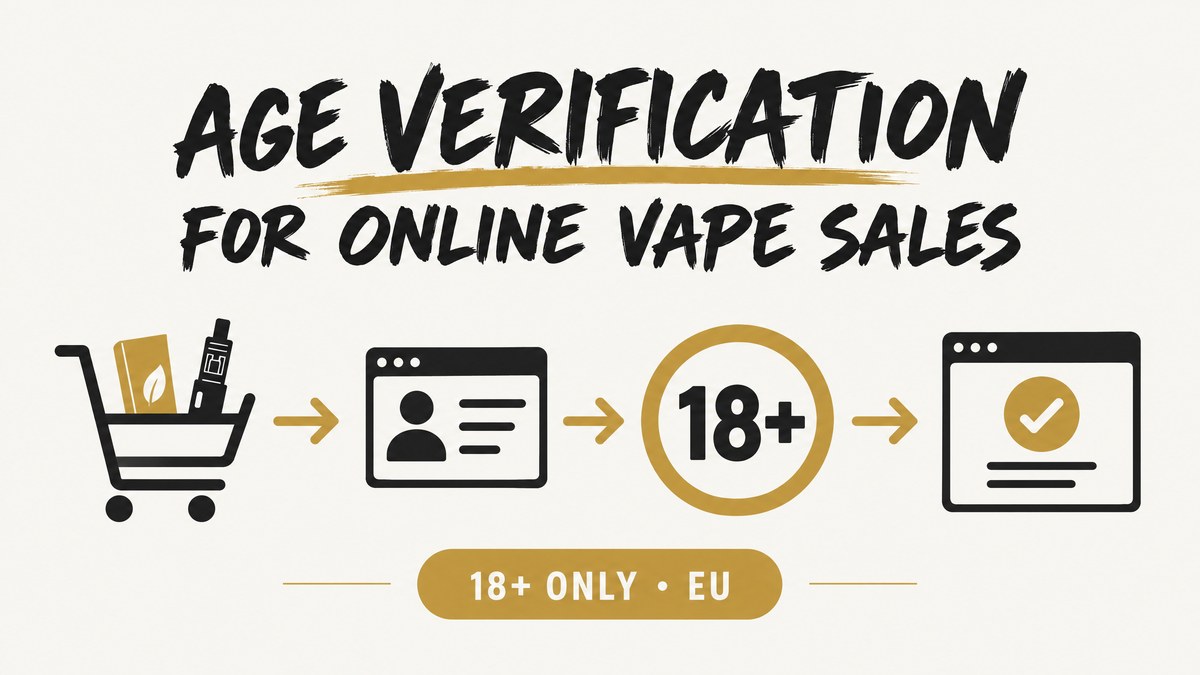
- The 18+ age verification record for the transaction examined.
Age verification is a Member State rule, but 18+ is the floor. Record date, time, SKU, method — a photographic ID, or a certified age-estimation tool where national law allows — outcome, and staff initials. Keep it with the batch and traceability file for the on-sale period plus the national post-delisting rule; a loose note at the till is not a record. Log refused sales the same way, and reconcile the age-verified sales log against the Article 20(7) annual extract.
Where the paperwork meets the rest of the compliance file
The supplier due diligence checklist covers how to assess the company sending these files; the logistics, shipping and customs traceability guide covers how batch numbers travel with goods. When a multi-configuration device such as the Bang Legend 6-in-1 device listing goes on the shelf, the rule holds: one SKU folder, one label proof per market, one leaflet language, one batch record. Keep the folder at the point of sale.
Common failure points in a retailer document file
- A “certificate of compliance” with no EU-CEG submission ID replaces the Article 20(2) receipt.
- Label proofs are English-only while the shelf pack carries local-language labelling.
- The leaflet lists adverse reactions but omits addictiveness and toxicity.
- Batch codes sit on the delivery note but never reach the unit-level traceability row.
- Article 20(7) data is filed without the till extract reconciling the volumes.
- An Article 20(9) complaint is answered verbally with no dated log or corrective action.
- A revised label keeps the old file name, hiding which artwork was valid on a given date.
Each is a filing error, not a product defect, and each yields to one habit: one SKU folder, one version index, one goods-in signatory. A retailer that produces the EU-CEG receipt, the label proof valid on the sale date and the batch code in under two minutes has the documentation side covered.
FAQ
Which document proves a device was notified before it reached my shelf?
The EU-CEG receipt from the Member State’s competent authority. Article 20(2) of Directive 2014/40/EU requires it six months before the market date, in the format of Commission Implementing Decision (EU) 2015/2183. Match its ID, date and product name to the SKU; an invoice has none of these.
How long do I keep the papers for a product I no longer stock?
No harmonised EU figure fixes retailer retention. Keep the EU-CEG receipt, label proofs, leaflet, declaration of conformity and batch records for the on-sale period, then as the Member State requires after delisting; ask the competent authority for the current rule. Article 20(7) extracts and Article 20(9) logs stay in the closed folder.
What nicotine figure belongs on the label and in the file?
Label and Article 20(2) dossier both carry 2%, the ceiling written as 20 mg/ml (2%) in Article 20(3)(b). The file cites the Article 20(3)(a) limits: 2 ml for tanks and cartridges, 10 ml for refill containers. Ingredient list, health warning and instructions for use sit alongside; a different figure fails at goods-in.
What changes when a flavour or label artwork is revised?
A new or substantially modified product needs a fresh Article 20(2) notification six months before its market date, so a new EU-CEG receipt, re-approved label proofs, a reprinted leaflet and a re-signed declaration of conformity follow. Close the old version, name new files with a version number and date, and keep both.
What do I hand over during a trading standards visit?
Produce the EU-CEG receipt, the Article 20(2) dossier reference, the signed declaration of conformity naming Commission Implementing Decision (EU) 2016/586, the approved label proof, the local-language leaflet, the batch and traceability record, the Article 20(9) log, and the 18+ age verification record. All eight sit in one SKU folder.
Who records the 18+ age check and for how long?
The till staff member records date, time, SKU, method (photographic ID, or a certified age-estimation tool where national law allows), outcome and initials; refused sales get the same fields. 18+ is the EU floor, and retention follows the on-sale period plus the national post-delisting rule, kept with the batch record. Reconcile against the Article 20(7) annual extract.
Next steps
Build one SKU folder per product from the eight-row matrix, run the 10-minute goods-in sequence on the next delivery, and put a version index at the front. For the current document set behind a specific line, contact the PuffCell EU team with the SKU and market and request the EU-CEG receipt reference, label proof and leaflet language.
Last reviewed: 5 November 2026
Shop the range
Looking for the devices these guides are about? These models are currently in stock and ship from our EU warehouse.