

Illegal Vapes in Australia: What’s Actually Happening in 2026
Updated 14 September 2026 · 8 minute read · Reviewed by the PuffCell team
Short answer: Vapes cannot be sold by ordinary retailers in Australia. Therapeutic vaping goods are supplied through pharmacies and authorised pathways, and single-use vapes are banned from import, supply and commercial possession. Meanwhile the black market has grown to the point where authorities estimate about 80% of nicotine products consumed here are illicit. In 2026 that has shown up as record border seizures, contaminated stock containing an anaesthetic drug, and a run of lithium battery fires.
If you buy vapes in Australia, the ground has shifted under you twice in two years. First the retail channel closed. Then the products that were still available started arriving through channels nobody inspects. That second part is what 2026 has been about.
Here’s the short version of the year so far, then what it means if you’re the one holding the device.
Key numbers from 2026
- 5.8% — the share of Australians who smoke daily, a historic low (AIHW, July 2026)
- 6% — the share of Australians who currently vape, down from 7% (AIHW, July 2026)
- 80% — the estimated share of cigarettes consumed in Australia that are illegal, up from 12% in 2017 (ABS)
- 332 — lithium-ion battery incidents recorded by Fire and Rescue NSW in 2025 alone
- 10,000+ — estimated battery-related fires nationally each year
- Thousands — vapes seized by the Australian Border Force in joint WA and NT raids (September 2026)
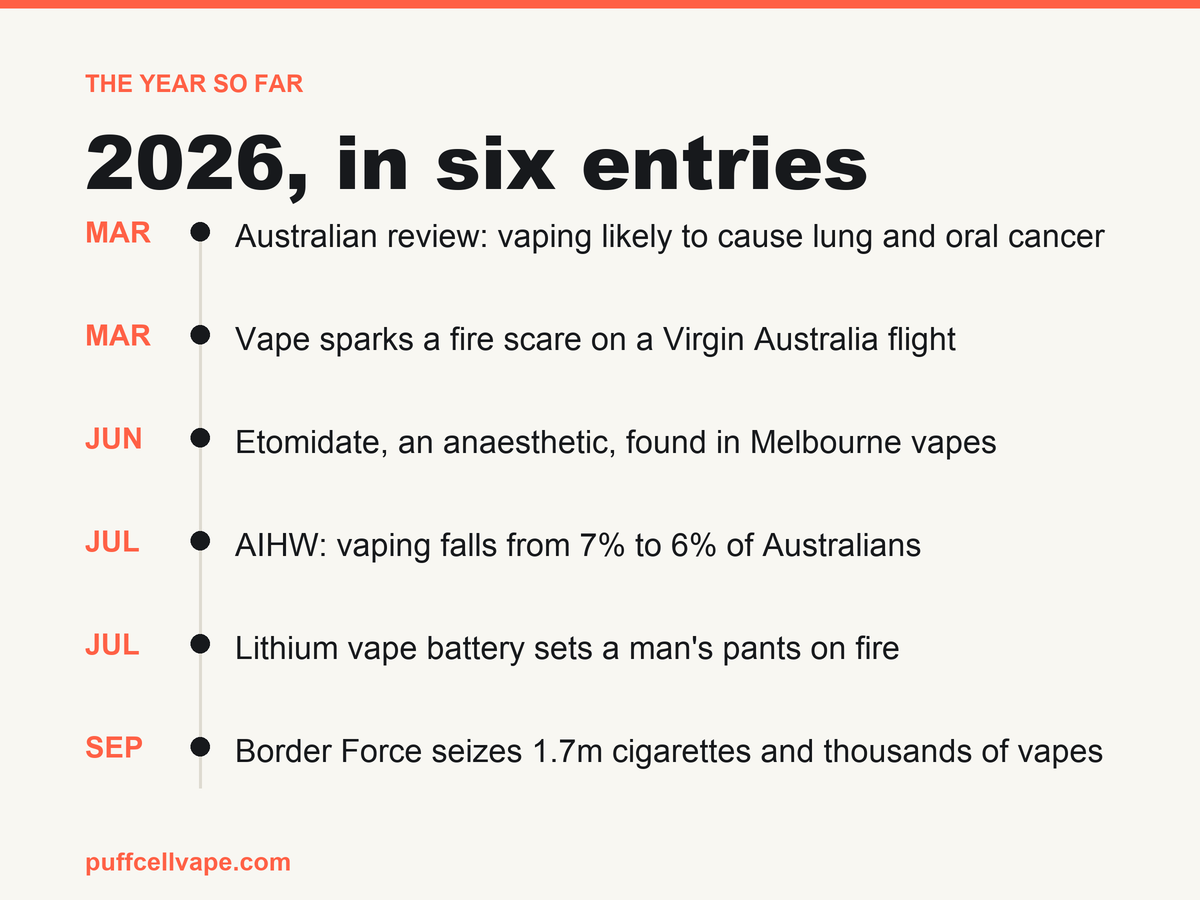
What’s happened so far this year
| When | What happened | Why it matters if you vape |
|---|---|---|
| Mar 2026 | An Australian review of the evidence concluded vaping is likely to cause lung and oral cancer | It moves vaping from “unknown long-term risk” to “probable carcinogen” in the published literature |
| Mar 2026 | A vape set off smoke on a Virgin Australia flight into Melbourne | Mid-air battery events are now a known category, not a freak accident |
| Jun 2026 | Victorian health authorities found etomidate, an anaesthetic, in illicit vapes sold in Melbourne | Illicit stock is not just untaxed vape juice; some of it contains drugs that stop your breathing |
| Jul 2026 | AIHW data showed vaping down to 6% and smoking at a record low | The reform worked on youth access, but multi-product nicotine use doubled |
| Jul 2026 | A lithium vape battery set a man’s pants on fire in Byron Bay | Loose cells in pockets are still the most underrated risk |
| Jul 2026 | Waste industry warned there is still no national vape disposal scheme | There is no safe, standard way to throw one away, and every council does it differently |
| Sep 2026 | Border Force seized over 1.7 million cigarettes and thousands of vapes in WA and NT raids | Enforcement is real, and it is aimed at supply, not at you |
| Sep 2026 | The government hired Deloitte (A$2.16m contract) to support the Illicit Tobacco and E-Cigarette Commissioner | The enforcement machine is being built out, not wound down |
| Sep 2026 | The Coalition proposed an 80% excise cut plus legal, taxed vapes and nicotine pouches | If it happens, the legal framework could change significantly – it is a proposal, not law |
The black market is now most of the market
Start with the number that explains everything else. The Australian Bureau of Statistics found that illicit nicotine products – vapes, loose-leaf tobacco, the lot – went from about 12% of consumption in 2017 to roughly 80% in 2025. The May budget forecast an $8 billion revenue shortfall over five years as a result.
When a market moves that far off the books, three things follow.
Price stops telling you anything. With excise around $30 on a pack of 20 cigarettes, the gap between legal and illegal product is wide enough to make smuggling worth the risk. A cheap price is not evidence of a good deal; it is the normal price of unregulated supply.
Quality control disappears. Nobody is checking nicotine concentration, ingredients or battery cells on stock that arrives outside the regulated system. That is how a Melbourne product ends up containing etomidate.
Enforcement gets serious, and it looks at sellers. The Australian Border Force raids in Western Australia and the Northern Territory in September 2026 turned up more than 1.7 million cigarettes and thousands of vapes. The new Office of the Illicit Tobacco and E-Cigarette Commissioner now has external contractors building the data and process side. If you sell, you are the target. If you buy a device for yourself, you are mostly a bystander to it.
Contaminated vapes: this is the part worth reading twice
In June 2026 the Victorian Department of Health issued an alert after etomidate was found in vapes sold in Melbourne. Etomidate is an anaesthetic used in hospital emergency settings. In small doses it causes deep sedation and dangerously slow breathing, and it is worse when mixed with alcohol, opioids, benzodiazepines or GHB.
The same alert warned about vapes sold as “space oil”, “k-pods” or “space vapes”, which may also contain potent novel opioids. Naloxone reverses an opioid overdose. It does not reverse etomidate.
You cannot detect any of that by looking at a device. What you can do is treat unlabelled stock as unknown stock, and be considerably more careful about anything sold under a nickname rather than a product name.
The cancer question got harder to ignore
In March 2026 an Australian review of the evidence concluded that vaping is likely to cause lung and oral cancer. That is a meaningful shift in the scientific conversation, though it is worth being precise about what it does and does not say.
What it says: across the available evidence, the pattern now points toward a causal link rather than a loose association.
What it does not say: that vaping is as harmful as smoking, or that a single device will give you cancer. Risk scales with dose, duration and what is actually in the product.
Australian health advice has not changed in its practical shape. Vaping is not harmless and it is not for people who don’t smoke or vape. If you are using nicotine and want to stop, the funded supports and pharmacy pathways exist for exactly that, and talking to a pharmacist is a genuinely useful step – pharmacists have been taking a bigger role in quit support through 2026.
Battery fires: the risk in your pocket
Battery incidents are the most common physical injury story in this market, and 2026 added more entries to the list.
- 5.8% — the share of Australians who smoke daily, a historic low (AIHW, July 2026)
- 6% — the share of Australians who currently vape, down from 7% (AIHW, July 2026)
- 80% — the estimated share of cigarettes consumed in Australia that are illegal, up from 12% in 2017 (ABS)
- 332 — lithium-ion battery incidents recorded by Fire and Rescue NSW in 2025 alone
- 10,000+ — estimated battery-related fires nationally each year
- Thousands — vapes seized by the Australian Border Force in joint WA and NT raids (September 2026)
- Byron Bay, July 2026: a lithium-ion vape battery ignited in a man’s pocket. Pants on fire is the literal headline.
- Melbourne, March 2026: a vape produced smoke on a Virgin Australia flight, triggering an emergency response on landing.
- New South Wales, 2025: Fire and Rescue NSW logged 332 lithium-ion battery incidents in a single year. Nationally, battery-related fires are estimated at more than 10,000 a year.
- September 2026: a mining safety regulator warned about “unprecedented” numbers of vapes being taken underground – an enclosed, high-risk environment where a thermal runaway is not a small problem.
The devices themselves are tiny power packs. A damaged or shorted cell does not smoulder politely; it vents, then it flares.
If you take one thing from this section: a swollen, dented or hot device is finished. Don’t charge it, don’t leave it in a car, and don’t put a loose battery in the same pocket as your keys.
How to dispose of a vape in Australia
There is no national scheme yet. The Commonwealth announced $12.5 million for a consumer vape disposal scheme, and as of mid-2026 the waste industry was still waiting for clarity on how it would work. So what you can do depends on where you live.
| Where you are | What’s available | What to watch for |
|---|---|---|
| NSW | Embedded battery trial running across 34 councils; mandatory product stewardship for batteries from October 2026 | The scheme is designed around identifiable, lawful producers – illicit vapes fall outside it |
| Queensland | 14 councils funded under a $2 million program; 88 permanent battery collection points plus temporary drop-offs | Vapes are usually not accepted in mixed battery bins because of the nicotine |
| Other states | Council e-waste and battery drop-offs, advice varies | Call ahead: many sites now ask you to tape terminals and separate the device |
| Everywhere | Never the kerbside bin | Damaged lithium cells are a known cause of truck and facility fires |
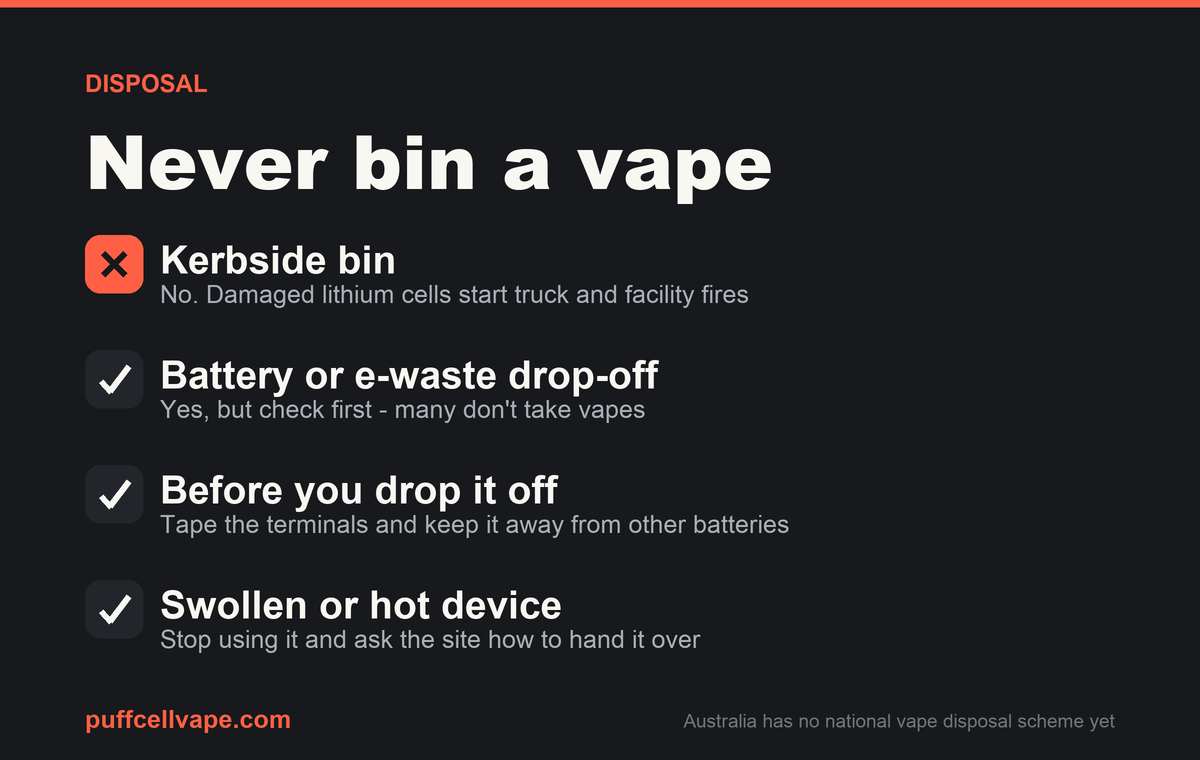
Two practical notes. First, taping the terminals and keeping the device away from other batteries matters more than people think. Second, if a device is swollen or has been overheating, don’t toss it loose into a collection box – ask the site how they want it handled.
Five checks before you use anything
| Check | What it looks like on a compliant product | Red flag |
|---|---|---|
| Warning statement | Required warning text on the packaging | No warning at all, or a warning that reads like marketing copy |
| Nicotine strength | Printed in mg/mL | Only a percentage, only a flavour, or nothing |
| Batch or lot number | Present, with an expiry date | Missing – which means no recall can ever reach you |
| Supplier identity | Named manufacturer and an Australian point of contact | A brand name and nothing else |
| Supply pathway | Product supplied through the therapeutic pathway | Sold under a nickname like “space oil”, or from a seller who will not say where stock came from |
If a product fails two or more of those, don’t guess. Our FAQ page covers the questions we get asked most often, and if you’re looking at a listing from somewhere else entirely, the TGA’s guidance on therapeutic vaping goods is the source that actually decides the answer.
What we can and can’t tell you at PuffCell
We sell vapes, so it would be strange to write this piece and then pretend the awkward parts don’t apply to us. Here is a straight version.
What we can do. We publish the device and flavour details on each product page, including the puff rating and the nicotine strength as labelled. Devices ship from our Australia warehouse for local delivery, and we publish shipping and order tracking information so you know what is happening after checkout.
What we do about faults. Every device comes with our 1-year warranty, and battery or charging faults are exactly the sort of thing it exists for. If a device arrives swollen, damaged or behaving badly, stop using it and start a return instead of pushing it through another charge cycle.
What we can’t tell you. We can’t declare a product lawful for your circumstances, and we can’t make Australian supply rules disappear. Neither can any other store operating in this market, whatever their homepage says. What a store can do is be verifiable, which is why batch information matters more here than it does in most retail.
If you’re buying in volume, the compliance question comes before the sourcing question. Our wholesale page explains how bulk enquiries work, and it is worth reading alongside our guide to Australia’s pharmacy access rules before committing to stock.
Frequently asked questions
Are vapes illegal in Australia in 2026?
Vapes are not banned for personal possession in the way many people assume, but supply is tightly controlled. Therapeutic vaping goods can only be supplied through pharmacies and authorised therapeutic pathways, and single-use and non-therapeutic vapes are banned from import, domestic manufacture, supply, commercial possession and advertising. In practice, that means the legal question is nearly always about who supplied the product and how it got here.
Can I still buy vapes from a shop?
Not from ordinary retail. Vape shops, tobacconists, convenience stores and market stalls cannot supply vapes in Australia. Online listings exist for products that cannot lawfully be supplied here, which is why a polished storefront proves nothing about the product behind it.
Why is there still a black market if retail sales are banned?
Because demand didn’t go away. The ABS data shows illicit nicotine consumption rising from roughly 12% in 2017 to about 80% in 2025, and the budget is carrying an $8 billion shortfall as a result. Crackdowns have been aimed at supply, and in September 2026 the Coalition proposed an 80% excise cut with legal, taxed vapes and nicotine pouches as an alternative approach.
How do I know if a vape is counterfeit or illegal?
You can’t confirm it by looking, but you can spot the absence of the basics: no warning statement, no nicotine strength in mg/mL, no batch or lot number, no traceable supplier. Products sold as “space oil” or “k-pods” are a separate warning sign after etomidate and novel opioids were found in Melbourne stock in June 2026.
What should I do with a used or dead vape?
Not the kerbside bin, ever. Use a council e-waste or battery drop-off, tape the terminals, and check first whether the site accepts vapes – many mixed battery bins don’t, because of the nicotine. There is still no national vape disposal scheme in Australia, so it pays to check locally.
Is the puff count on the box accurate?
Treat it as an estimate rather than a promise. Puff ratings assume a certain draw length and a device that is not working hard, so real-world use is usually lower – especially with a 9,000-puff device like the ones we stock. We wrote a full breakdown of what the 9,000-puff claim on the ALIBARBAR INGOT 9000 actually buys you, because it is one of the most common questions we get.
Is vaping safer than smoking?
The honest answer in 2026 is that vaping is not harmless, it is not for people who don’t smoke or vape, and the long-term picture is still being worked out – with a March 2026 Australian review concluding vaping is likely to cause lung and oral cancer. If you smoke and want to stop, talk to a pharmacist or GP about the options that exist rather than relying on a product listing.
The bottom line
The story of vaping in Australia in 2026 isn’t really about whether vapes are banned. It’s about what happens when the legal channel closes and the demand stays. Record seizures, an anaesthetic showing up in Melbourne vapes, and a steady drumbeat of battery fires are all symptoms of the same thing.
For anyone holding a device: read the label, treat unlabelled stock as unknown stock, keep the battery out of your pocket with your keys, and don’t put it in the bin. If you want to stop, the support exists and it is worth using.
This article is general information, not legal or medical advice. Australian federal, state and territory requirements change, and this page reflects reporting up to 14 September 2026. Check current official guidance before acting on anything here.
Sources
- 5.8% — the share of Australians who smoke daily, a historic low (AIHW, July 2026)
- 6% — the share of Australians who currently vape, down from 7% (AIHW, July 2026)
- 80% — the estimated share of cigarettes consumed in Australia that are illegal, up from 12% in 2017 (ABS)
- 332 — lithium-ion battery incidents recorded by Fire and Rescue NSW in 2025 alone
- 10,000+ — estimated battery-related fires nationally each year
- Thousands — vapes seized by the Australian Border Force in joint WA and NT raids (September 2026)
- Byron Bay, July 2026: a lithium-ion vape battery ignited in a man’s pocket. Pants on fire is the literal headline.
- Melbourne, March 2026: a vape produced smoke on a Virgin Australia flight, triggering an emergency response on landing.
- New South Wales, 2025: Fire and Rescue NSW logged 332 lithium-ion battery incidents in a single year. Nationally, battery-related fires are estimated at more than 10,000 a year.
- September 2026: a mining safety regulator warned about “unprecedented” numbers of vapes being taken underground – an enclosed, high-risk environment where a thermal runaway is not a small problem.
- AIHW via ABC News: vaping rates decline as smoking hits historic low (17 July 2026)
- Victorian Department of Health alert on etomidate in illicit vapes (June 2026)
- Waste Management Review: why Australia needs a national vape disposal scheme (16 July 2026)
- 2FIRSTS: Deloitte engaged to support illicit tobacco and vape enforcement (September 2026)
- 2FIRSTS: Coalition plan for excise cuts and legal, taxed vapes (September 2026)
- TGA: therapeutic vaping goods
- TGA: advertising and promotion of vapes
- Healthdirect: vaping