Richiami di svapo e segnalazione di effetti avversi ai sensi dell'articolo 20, paragrafo 9
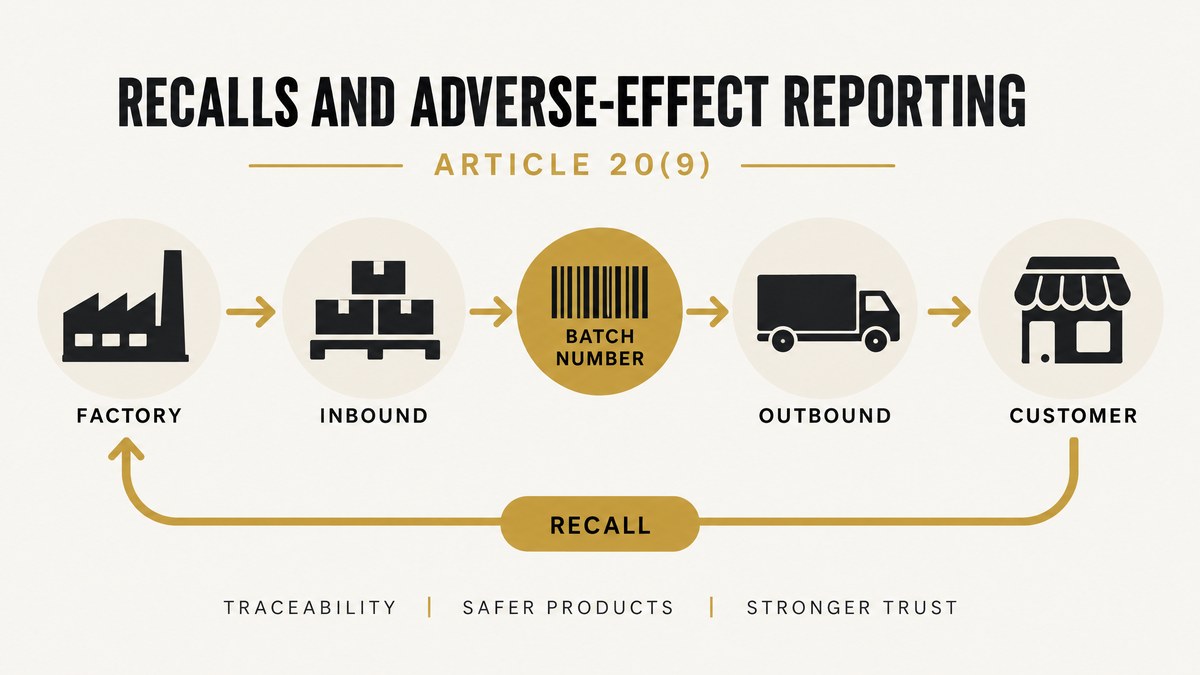
A retail account flags three complaints about one lot of 2% nicotine e-liquid on a Tuesday morning in November 2026: a leaking refill container, a burnt taste, and a customer reporting mouth irritation. Before a vape product recall EU TPD procedure starts, the wholesale file has to name the EU-CEG notification number, the Article 20(4) batch number on the unit packet, the operator logging the suspected adverse effect, and the corrective action written down under Article 20(9) of Directive 2014/40/EU. Vape recalls and adverse-effect reporting under Article 20(9) are a chain of records, not one form. Below: the responsibility split, the separate Article 20(7) stream, a broken batch number rebuild, and a six-step recall drill for 18+ buyers.
What Article 20(9) puts on the wholesale file
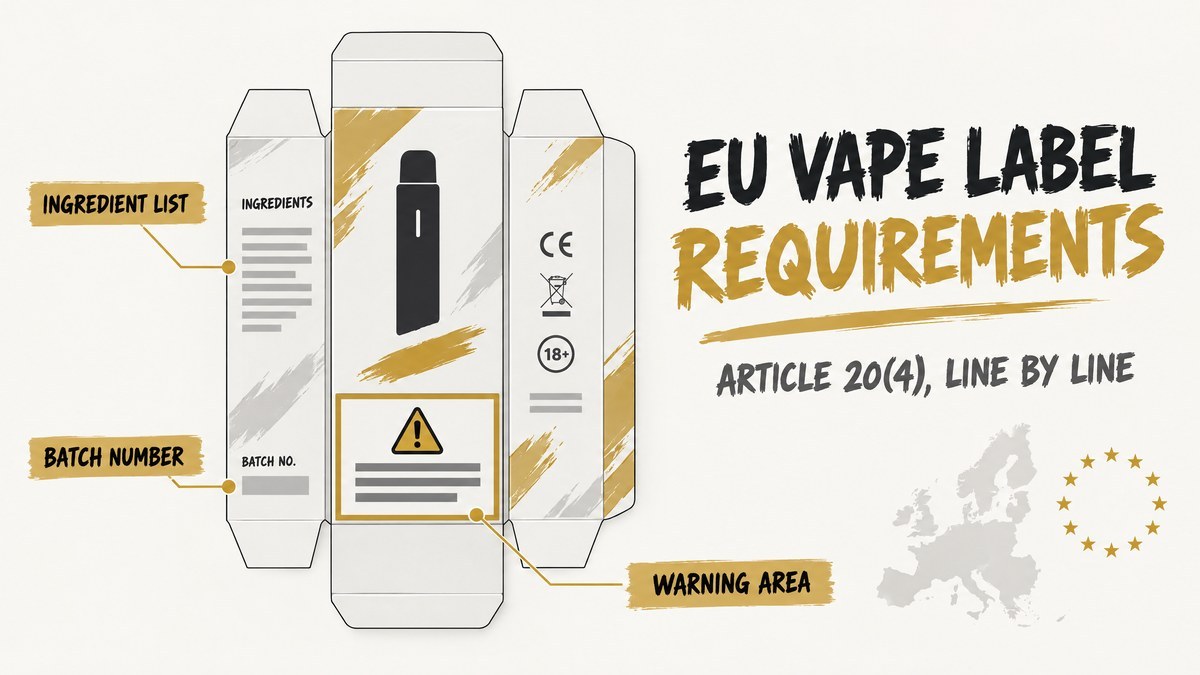
Directive 2014/40/EU entered into force on 19 May 2014 and applied from 20 May 2016. Article 20(2) requires a six-month advance notification through EU-CEG under Implementing Decision (EU) 2015/2183, covering ingredients, emissions, toxicology, nicotine dose and uptake, and the production process. Article 20(3)(b) caps nicotine at 20 mg/ml (2%); Article 20(3)(a) limits tanks to 2 ml and refill containers to 10 ml, quoted here as regulatory references, not fill declarations. Article 20(4) puts the batch number, warnings and adverse-effect information on the unit packet and leaflet.
Article 20(9) obliges economic operators to collect suspected adverse-effect information and take corrective measures; it names no single EU-wide form, deadline or addressee. The output is a case file: intake log, lot trace, corrective action, downstream notice and archive entry. Keep the full text of Directive 2014/40/EU on EUR-Lex e il Commission’s electronic cigarettes regulation page beside the EU-CEG receipt; the Guida alla conformità all'ingrosso di vaporizzatori nell'UE maps the wider structure.
Label these documents before the first complaint arrives:
- EU-CEG dossier with the Article 20(2) six-month submission date.
- Adverse-effect log with case reference, lot code and reporter channel.
- Corrective-action note with manufacturer and importer signatories.
- Batch reconciliation sheet linking the goods-received note to the pallet label.
Responsibility matrix for a recall and adverse-effect report
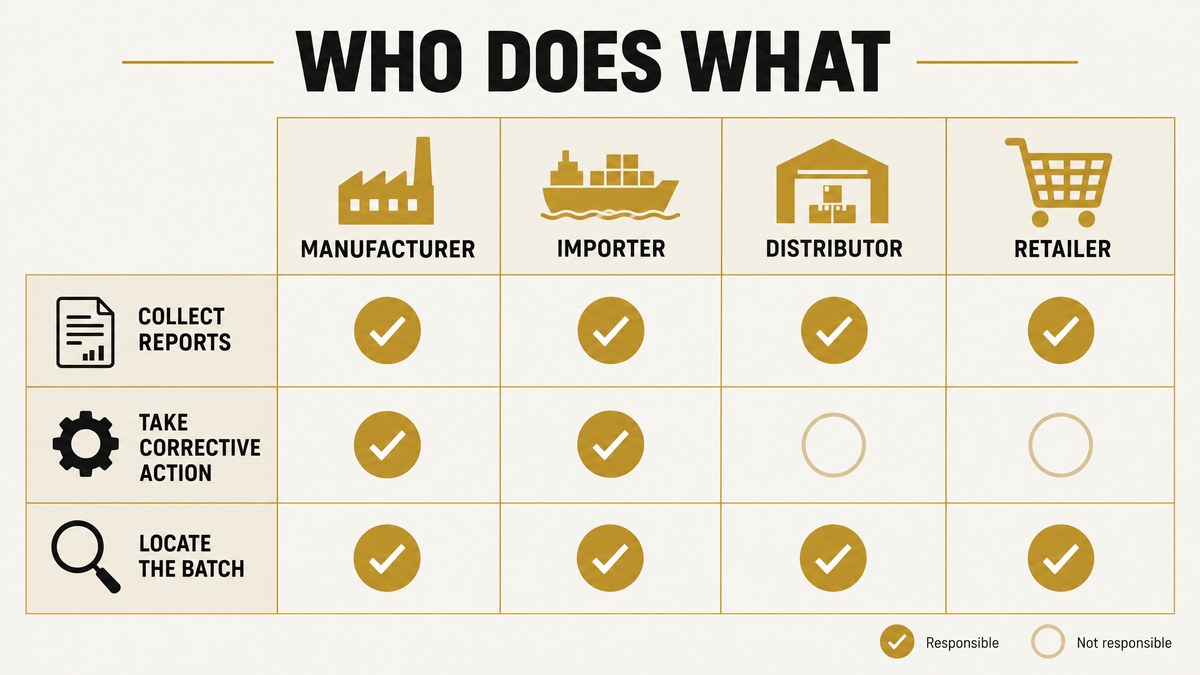
Article 20(9) addresses economic operators, not one duty holder. The matrix gives each action a named owner and a named document; it is written for a 2% product notified under Article 20(2) and sold to an 18+ customer.
| Action | Produttore | Importer | Wholesaler | Retailer | Record |
|---|---|---|---|---|---|
| Suspected adverse-effect intake, Article 20(9) | Assesses the technical cause | Opens the case reference | Forwards lot code and complaint | Logs the customer report | Adverse-effect log |
| Batch and lot location | Confirms production date code | Reconciles goods-received note | Flags the pick face | Counts shelf units | Batch reconciliation sheet |
| Quarantine and hold | Advises on release | Issues the hold instruction | Sets the warehouse hold flag | Removes units from display | Hold notice with quantity |
| Corrective action, Article 20(9) | Signs root-cause finding | Countersigns the decision | Applies it to the bins | Applies it to the shelf | Corrective-action note |
| Customer notification | Supplies technical wording | Approves notice and account list | Notifies every holding account | Passes wording to the 18+ buyer | Customer notice and account list |
| Reporting to the authority | Supplies EU-CEG number | Submits report, keeps acknowledgement | Supplies lot quantities | Supplies complaint records | Authority acknowledgement, Article 20(9) |
| Archiving and retrieval | Retains technical file | Retains authority correspondence | Retains notice and drill result | Retains till-side record | Archive index, separate from Article 20(7) |
Reading the record column
Each row ends in a document, not a tick. Retrieve one case reference and produce all six downstream papers from the index; the EU vape product documentation retailer checklist lists the retailer’s side.
Article 20(9) versus Article 20(7): two separate streams
Article 20(7) is an annual, aggregate return of sales data and consumer preferences, filed through the EU-CEG environment used for the Article 20(2) notification. Article 20(9) is event-driven: one suspected adverse effect on one lot, producing a case-level record and a corrective action. A filed annual return does not discharge an open case, and a single adverse-effect note does not replace it.
| Dimension | Article 20(7) annual return | Article 20(9) adverse-effect stream | Record to retain |
|---|---|---|---|
| Trigger | Reporting year | One adverse effect on one lot | Case reference or return receipt |
| Content | Sales volumes and preferences | Complaint, lot code, root cause | Adverse-effect log |
| Recipient | Authorities via EU-CEG | Authority handling the case | Authority acknowledgement |
| Output | Data return and preference survey | Corrective measure or no-action decision | Signed decision |
| Archive owner | Importer, annual series | Importer, case series | Two separate index series |
Two binders, two index series
The Article 20(7) binder holds sales volumes, preference data and the six-month EU-CEG dossier under the reporting year. The Article 20(9) series is organised by case reference: intake log, lot trace, notice, acknowledgement and closure note, filed apart from the annual return.
Rebuilding a broken batch number
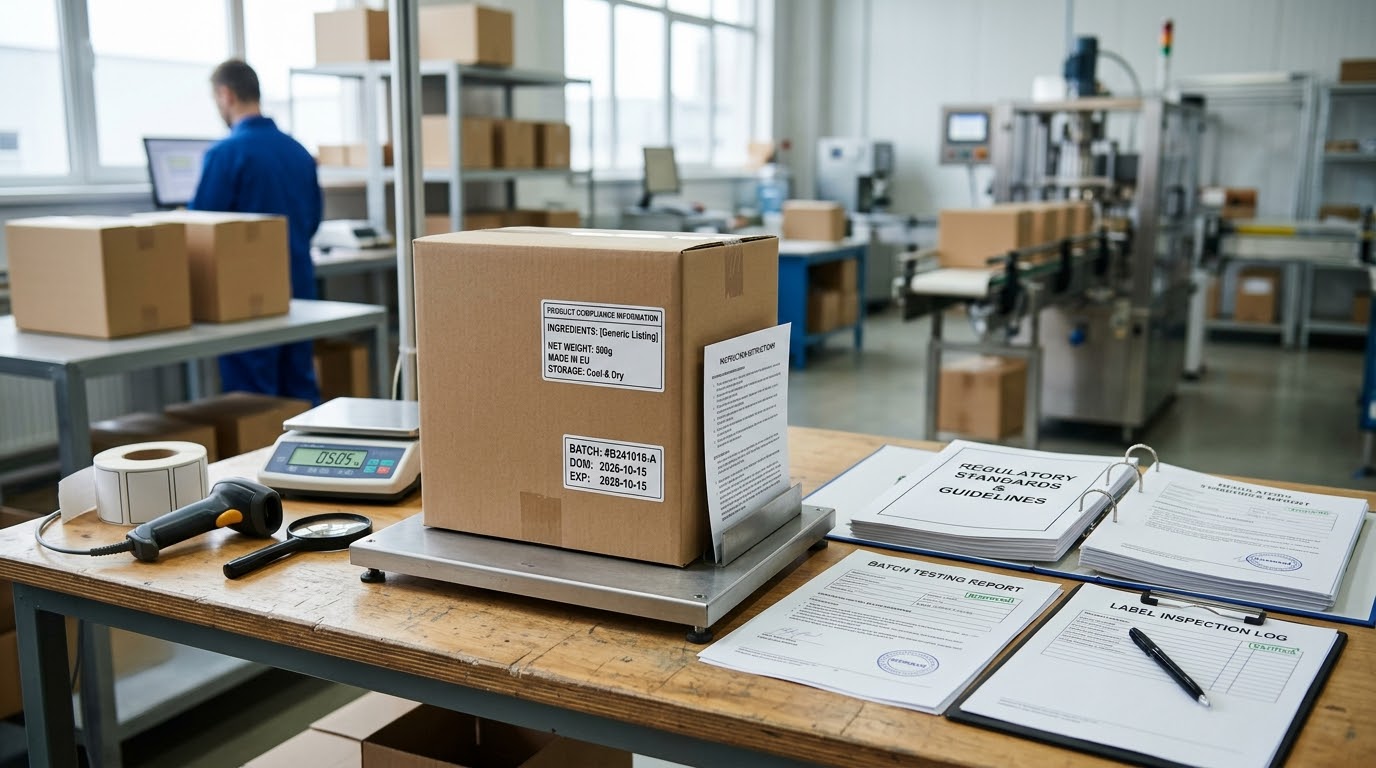
The trace breaks when an outer carton label is scuffed, the unit packet and carton carry different codes, or a split pallet loses its link. Article 20(4) still requires the batch number on the unit packet, so reconstruct rather than relabel: over-stickering destroys the tie to the Article 20(2) notification. Photograph the damage, then match the EU-CEG number and production date code against the invoice, goods-received note, pallet manifest and pick-face record. Record every source on a batch reconciliation sheet marked “reconstructed” — an auditable inference, not a recovered original.
IL logistics, shipping and customs traceability checklist covers inbound documents, the vape inventory batch rotation guide covers split pallets, and the EU vape label requirements page covers the unit packet. Reconcile the pack code to one notification on multi-flavour units such as the Bang Blaze 140K 3-in-1 product page. If no chain can be rebuilt, quarantine the lot as unidentified, notify the importer, and hold it from the 18+ channel until a corrective-action note is signed.
Recall drill: six internal steps, written as targets
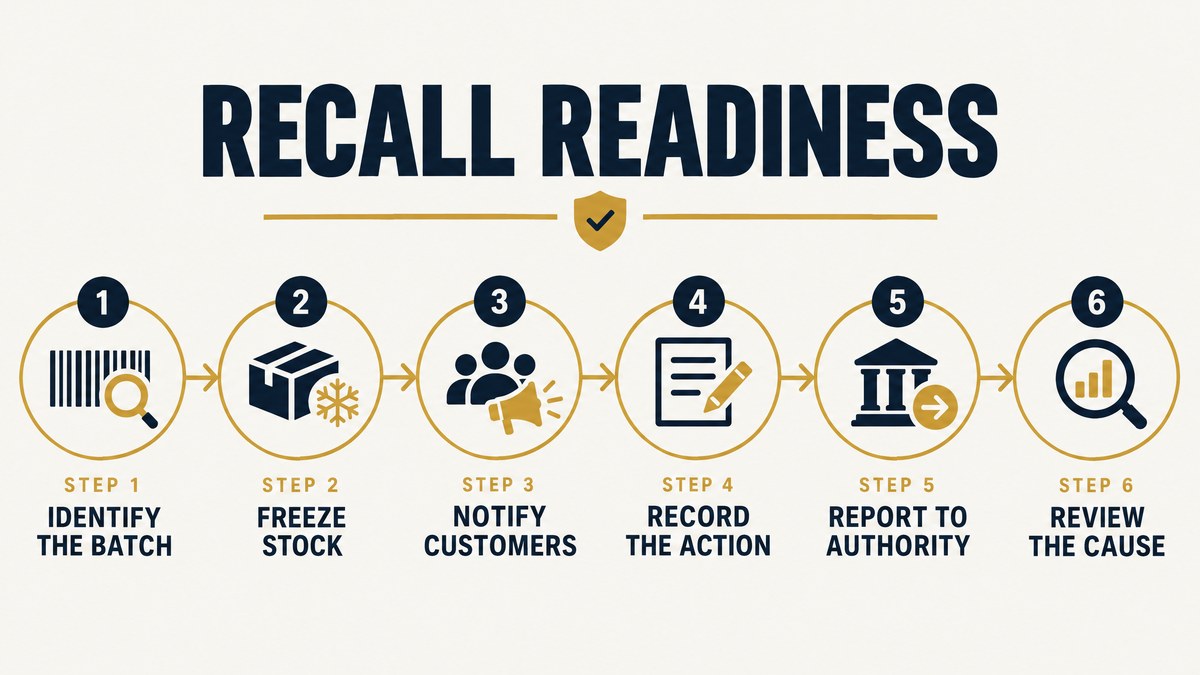
The six steps are internal targets for the exercise, not statutory deadlines; no number below is a legal clock. Use the returns and warranty procedure for retailers as the scenario.
- Intake: open a case reference with lot code, reporter channel and date. Target: every complaint numbered before the shift ends.
- Freeze: hold the lot and pick face. Target: no unit leaves the warehouse once the flag is set.
- Reconcile: rebuild the trail from the goods-received note, pallet manifest and EU-CEG number. Target: one signed reconciliation sheet per lot.
- Decide: obtain a corrective-action note signed by the manufacturer and countersigned by the importer. Target: a written decision, including a reasoned no-action outcome.
- Notify: one wording to every account holding the lot. Target: account list and notice log match line for line.
- Close: file the pack and run a retrieval test. Target: any document found from the archive index without the original handler.
Collect the outputs:
- Adverse-effect log with case reference and lot code.
- Signed batch reconciliation sheet naming each source.
- Corrective-action note with two signatories.
- Customer notice and the account list.
Assembling the evidence pack, and where 18+ and 2% sit
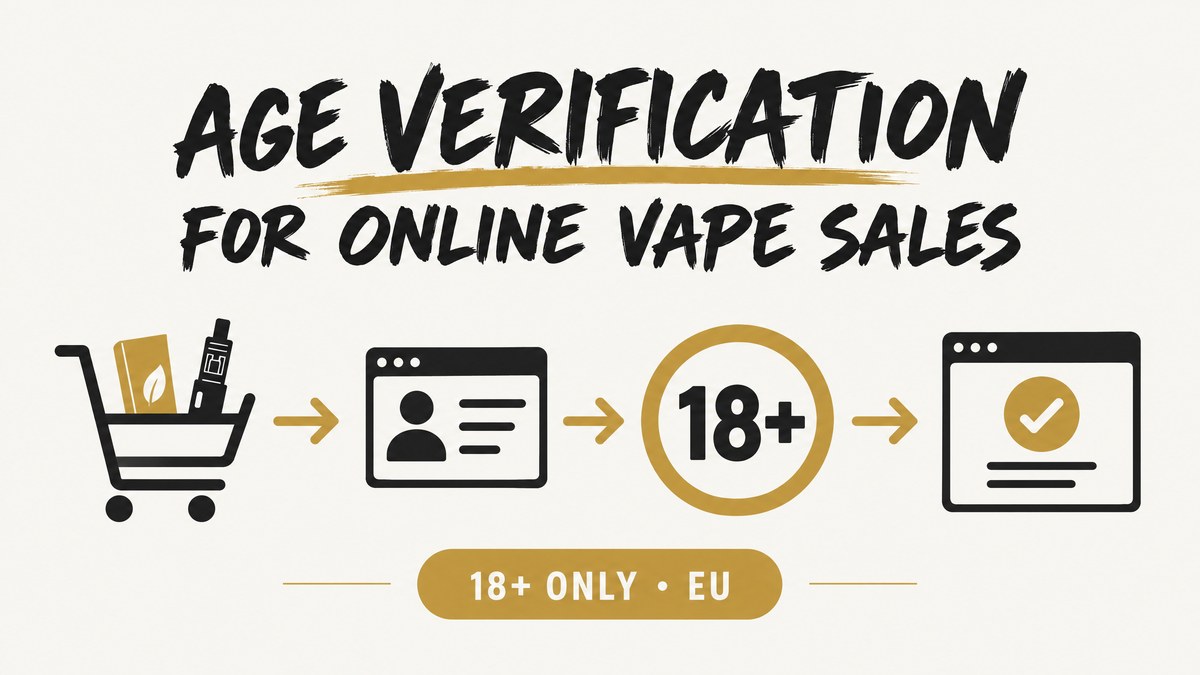
Hand over one indexed set organised by case reference, with the Article 20(7) annual series in a separate binder and the 18+ age-verification record beside the customer notice. The online 18+ age verification guide describes the distance-sales check.
Article 20(3)(b) at 20 mg/ml (2%) and Article 20(3)(a) at 2 ml for tanks and 10 ml for refill containers appear as regulatory references only, never as fill declarations. For devices, Directive 2012/19/EU on waste electrical and electronic equipment e Regulation (EU) 2023/1542 on batteries sit in the same box; their entry-into-force and application dates are to be rechecked on EUR-Lex and in the Official Journal. Member States may add a notification fee, excise duty, local-language labelling, flavour restrictions, distance-sales limits and 18+ age verification: confirm which applies with the competent authority and retain the receipt.
What the archive box holds
Case series, annual series, EU-CEG dossier and a one-page index naming each owner. A quarterly retrieval test run by someone who did not handle the case measures whether the archive works.
FAQ
Does Article 20(9) set a fixed deadline for reporting a suspected adverse effect?
Article 20(9) of Directive 2014/40/EU, applicable from 20 May 2016, requires collection and corrective measures but states no EU-wide day count. The six-month clock in Article 20(2) covers the pre-market EU-CEG notification, not a recall. Confirm the authority’s procedure with the importer and recheck any national timetable on EUR-Lex.
Who collects suspected adverse effects — the manufacturer or the retailer?
Article 20(9) covers economic operators. The retailer takes the report, the importer opens the case reference, the manufacturer signs the corrective-action note, and the wholesaler supplies lot quantities. The seven-row matrix gives each role a named document, with the Article 20(4) batch number as the common key.
How does an Article 20(9) file differ from the Article 20(7) annual return?
Article 20(7) is an annual return of sales data and consumer preferences, filed through EU-CEG beside the Article 20(2) six-month dossier. Article 20(9) is event-driven: one adverse effect, one lot code, one corrective-action note. A filed annual return does not close an open case, so the two sit in separate index series.
What can a wholesaler do when the batch number on a carton is unreadable?
Do not relabel the unit packet: Article 20(4) requires the batch number there. Photograph the damage, then rebuild the trail from the EU-CEG number, invoice, goods-received note, pallet manifest and production date code, recording each source on a reconciliation sheet marked “reconstructed”. If no chain can be rebuilt, quarantine the lot as unidentified and request a corrective-action note.
Does a recall drill need a statutory timetable?
No. The six-step drill sets internal targets — intake, freeze, reconcile, decide, notify, close — scored on completeness, not a legal clock. Each step produces a named output such as a signed batch reconciliation sheet, and a retrieval test closes the exercise. File the result with the Article 20(9) case series beside the 18+ record and the 20 mg/ml (2%) reference.
Which nicotine and volume limits appear in a recall file?
Article 20(3)(b) caps nicotine at 20 mg/ml (2%) and Article 20(3)(a) limits tanks to 2 ml and refill containers to 10 ml; both are regulatory references, not fill declarations. Article 20(4) governs the batch number and warnings, and 18+ verification sits with the account list. Recheck Directive 2012/19/EU and Regulation (EU) 2023/1542 on EUR-Lex.
Prossimi passi
Run the seven-row matrix and six-step drill against one lot in your 18+ catalogue and note the missing archive documents. To map the vape product recall EU TPD file structure onto your SKUs, contact the PuffCell EU wholesale team with the EU-CEG number and batch field you use.
Ultima revisione: 5 novembre 2026