EU Vape Compliance Basics for Wholesale Businesses
A pallet of disposable devices reaches a wholesaler’s warehouse with an invoice and a supplier’s declaration of conformity. The buyer asks: where is the EU-CEG notification receipt, and was it lodged six months before the first unit was placed on the market? Without that date, the cartons are a compliance problem, not stock. EU vape compliance basics for wholesalers begin with that paperwork clock, not the device. This page explains TPD Article 20 as a baseline: regulated products, clause-to-duty mapping, national add-ons, and the files a wholesale business holds. Written for buyers serving adults aged 18+. The EU vape wholesale compliance guide covers the wider structure; this page stays with the foundations.
What Article 20 of the TPD actually covers
Scope, dates and the legal text
Directive 2014/40/EU entered into force on 19 May 2014 and applied from 20 May 2016. Article 20 governs electronic cigarettes and refill containers: a product for consuming nicotine-containing vapour via a mouthpiece, any component of it, or a container holding such liquid. The Commission’s electronic cigarettes page and the page on implementing the Directive list the secondary acts. Two matter wholesale: 2015/2183 fixes the EU-CEG format; 2016/586 fixes the child-resistant, tamper-evident refill standard.
- 20(2) dossier: manufacturer and importer details, ingredients, emissions, toxicology, nicotine dose and uptake, components, process, responsibility declaration.
- Filed via EU-CEG in the 2015/2183 format to each intended Member State’s competent authority.
- Six months before first placing on the market; a material change needs a fresh notification.
Five product categories and the triggers each one sets off
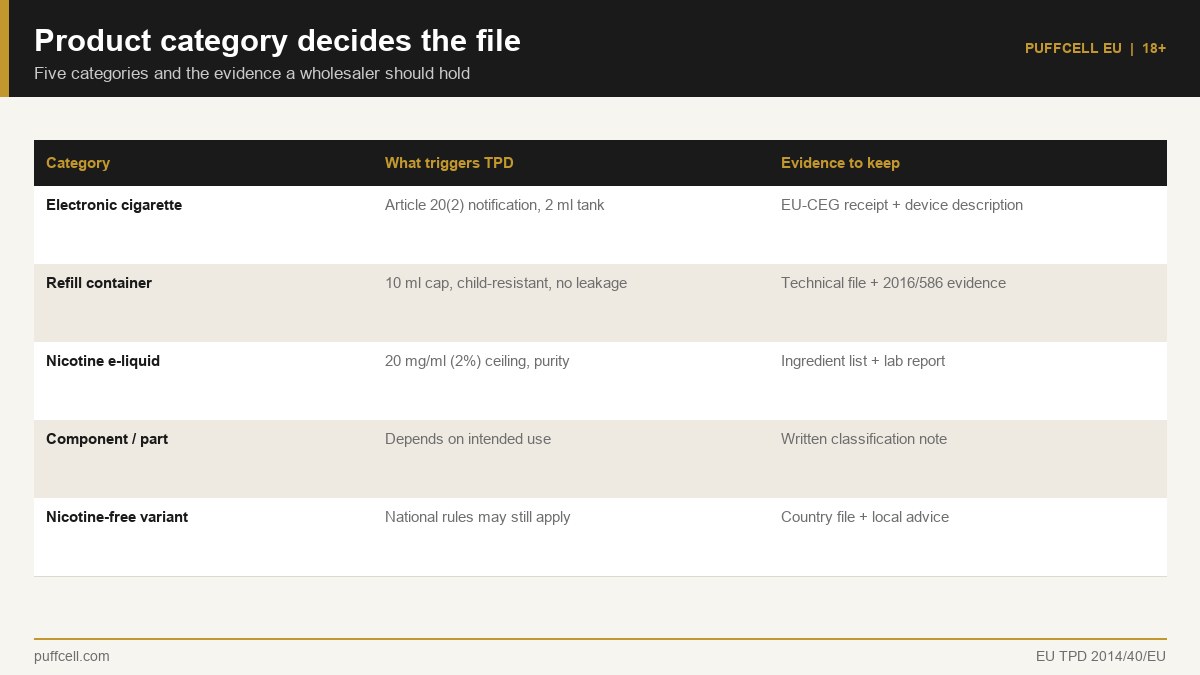
One carton can hold items in different legal buckets. Consider a multi-flavour disposable device: as a finished electronic cigarette it falls within 20(1), yet each distinct liquid formulation is a separate 20(2) notification entry even when the hardware is identical.
| Category | Typical Article 20 trigger | Evidence to retain | Common classification error |
|---|---|---|---|
| Electronic cigarette (finished device) | 20(1); 20(2) notice; 20(3)(a) 2 ml; 20(3)(g); 20(4) leaflet | EU-CEG receipt with date; conformity declaration; artwork | Filed as hardware, pre-filled liquid omitted |
| Refill container | 20(3)(a) 10 ml; 20(3)(b) 20 mg/ml (2%); 20(3)(g) per 2016/586; 20(4) batch number | Capacity and concentration reports; mechanism test; batch log | Assumed exempt because under 10 ml |
| Nicotine-containing e-liquid | 20(3)(b) 20 mg/ml (2%); 20(3)(c)-(e) additives; 20(3)(f) dose consistency | CAS ingredient list; certificate of analysis; emissions data | Percentage quoted instead of the legal ceiling; toxicology omitted |
| Component (coil, tank, mouthpiece, battery) | 20(1) components in scope; 20(2) component list; 20(3)(g) containment parts | Dossier component list; supplier declaration; drawing | Treated as consumer electronics |
| Nicotine-free variant (no nicotine, or unfilled device) | 20(1) intended use; national rules often extend duties; 20(4) may attach | Classification note; per-market assessment; ingredient list; 18+ record | Assumed an automatic exemption |
On a wholesale document the nicotine figure is always the 2% ceiling, written 20 mg/ml (2%) when quoting the law; 2 ml and 10 ml are legal limits. A supplier without the EU-CEG receipt and concentration certificate belongs in the supplier due diligence checklist, not the order book.
Article 20 clause by clause: requirements, owners and files
Wholesale staff need the owner of each duty and the document proving it. The manufacturer or importer is the party named in the EU-CEG dossier; a distributor holding stock is neither.
| Clause | Requirement | Who is responsible | Document left on file |
|---|---|---|---|
| Article 20(2) | Notify six months before placement: ingredients, emissions, toxicology, nicotine dose and uptake, device and process | Manufacturer or importer | EU-CEG receipt with date and dossier |
| Article 20(3)(a) | 2 ml in disposables or single-use cartridges; 10 ml in refill containers | Manufacturer; importer attests | Capacity report and tank drawing |
| Article 20(3)(b) | Liquid at or below 20 mg/ml (2%) | Manufacturer; accredited lab | Batch certificate of analysis |
| Article 20(3)(g) | Child-resistant, tamper-evident, leak-free; refill per 2016/586 | Manufacturer | 2016/586 test report and retained sample |
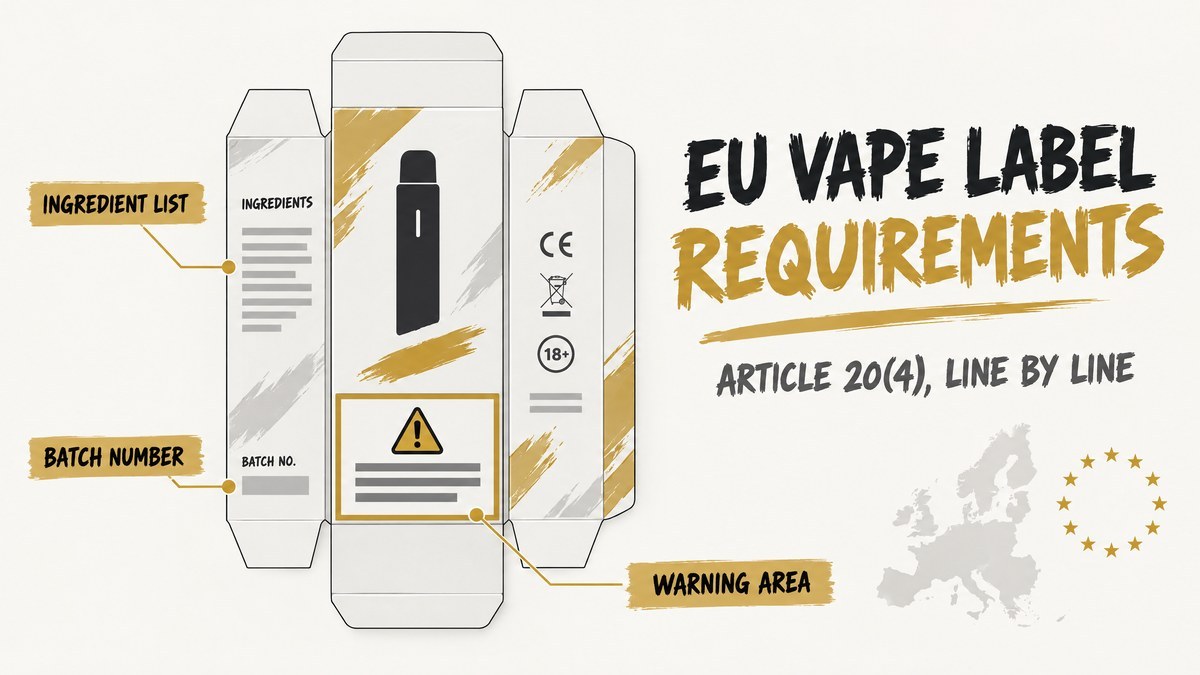
| Article 20(4) | Leaflet, ingredients, nicotine content, batch number, health warning; no promotional elements | Manufacturer or importer | Approved artwork and leaflet in each language |
| Article 20(7) | Annual sales volumes and consumer-preference data | Manufacturer or importer | Dated annual report and submission confirmation |
| Article 20(9) | Collect suspected adverse effects, inform the authority, take corrective measures | Manufacturer or importer; operators report upward | Adverse-effect register and corrective-action record |
Two patterns cause problems. The six months in 20(2) is a waiting period, not a processing target: a January notification does not clear a February listing. And 20(7) and 20(9) continue, so a compliant product lapses when the annual data or adverse-effect register stops.
EU baseline versus Member State add-ons
What the baseline fixes
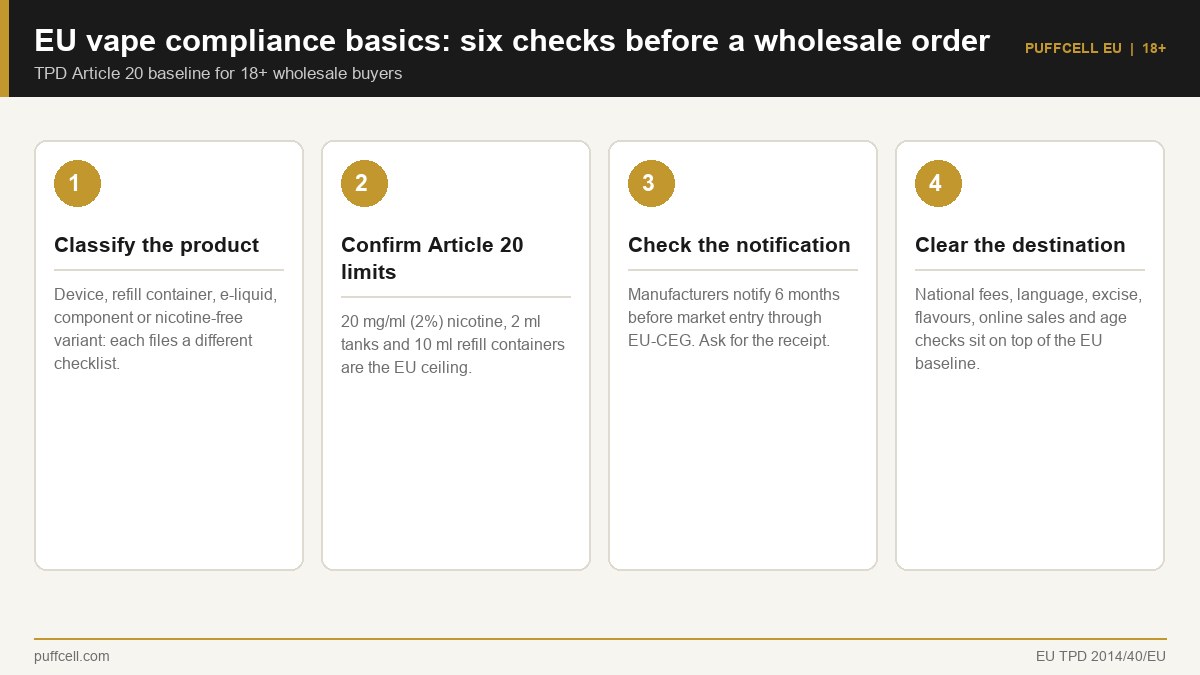
Article 20 sets one floor: the 2 ml and 10 ml limits, the 20 mg/ml (2%) ceiling, the six-month notification, the EU-CEG format, the 2016/586 refill standard, leaflet and health-warning content, the ban on promotional packaging and cross-border commercial communication, and the 18+ age gate.
What each Member State adds
A floor is not a ceiling. Six areas are decided nationally, so one notified product needs different treatment per destination. Confirm current requirements with the competent authority in the Member State before listing.
- Notification fees: 20(8) allows proportionate national charges.
- Excise duty: several states treat nicotine-containing e-liquid as excisable.
- Local-language labelling: 20(4)(c) leaves wording and language to national rules.
- Flavour restrictions: some states limit characterising flavours beyond 20(3)(c).
- Distance sales: registration is national; 20(5) restricts cross-border commercial communication.
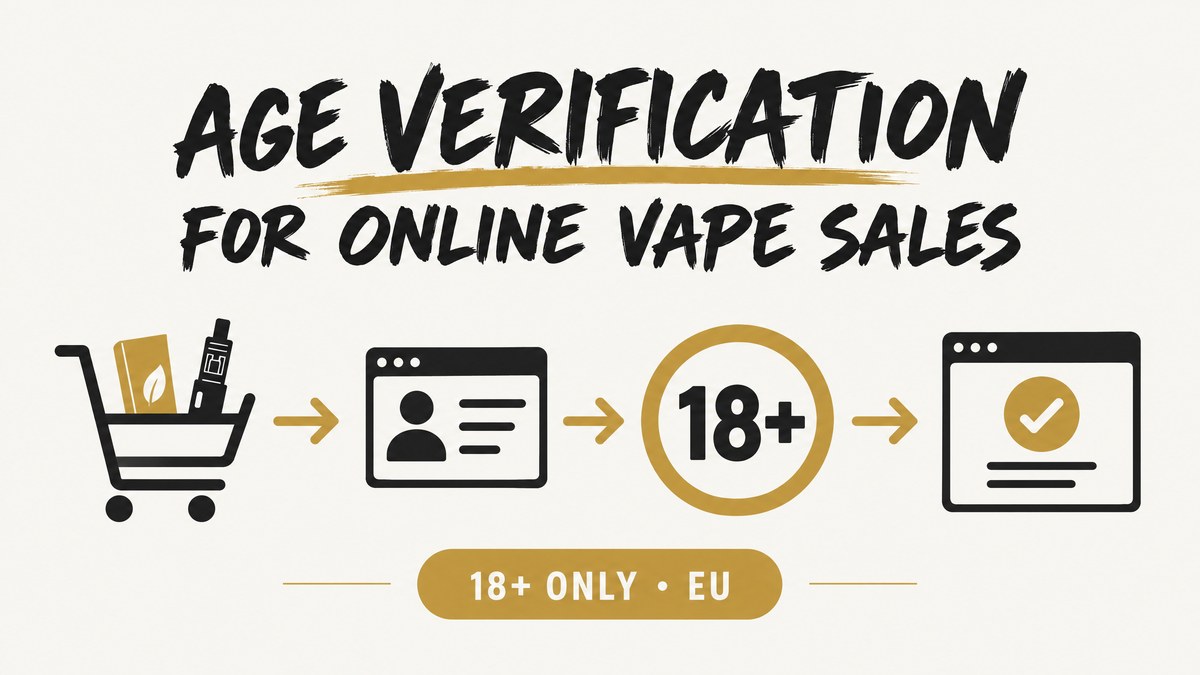
- Age verification: sale to adults aged 18+ is bloc-wide; the identity-check method is national.
For one worked example in a single market, use the Poland compliance checklist for selling vape products. Keep a dated market-entry sheet per destination recording which six were confirmed.
Exemptions, boundaries and who carries the duty
Why nicotine-free is not an automatic exemption
Article 20 covers products intended for nicotine-containing vapour, so buyers assume a liquid with no nicotine sits outside it. That fails three ways: 20(1) brings any component of an electronic cigarette into scope, so a device for nicotine vapour stays regulated; several Member States extend notification, labelling and 18+ duties to nicotine-free liquids; classification rests on intended use and device design, not the seller’s label. Treat “no nicotine” as a trigger for a written assessment, not a release.
A wholesaler is not the manufacturer, but still holds duties
The party named in the EU-CEG dossier owns the 20(2) notification, the 20(7) annual data and the 20(9) adverse-effect system. A wholesaler buying finished goods is neither, but sits inside the chain Article 20 assumes: identify the seller, hold evidence of notification before the six-month date, keep batch records linking a carton to a conformity declaration, and pass adverse-effect reports upward. Three files cover the position:
- The dated EU-CEG receipt and dossier extract.
- The batch-to-invoice record, maintained as in the logistics and customs traceability guide.
- The notified artwork, handed downstream through the retailer product documentation checklist.
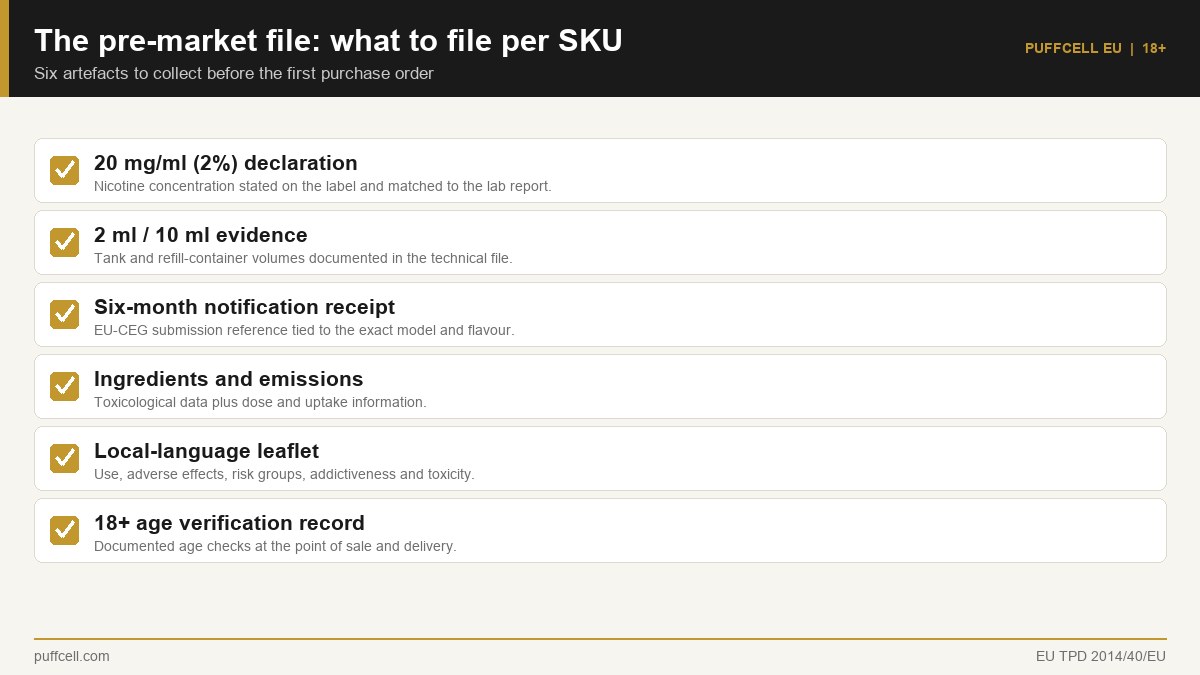
A six-step pre-market checklist with concrete outputs
The launch gate, with an output at each step. A file missing any of the six is not ready for a first order.
- Classify every SKU. Assign each line to one of the five categories. Output: a signed classification sheet with SKU, category, engaged clauses and decision date.
- Obtain notification evidence. Read the EU-CEG submission date against the planned first sale. Output: the dated receipt plus a note confirming the 20(2) six-month interval.
- Collect the limit reports. Match the 2 ml or 10 ml capacity report and the 20 mg/ml (2%) certificate to the batch, and file the 2016/586 mechanism test. Output: a batch-numbered test pack naming laboratory, method and values.
- Clear national add-ons. Log fees, excise duty, local-language labelling, flavour restrictions, distance sales and 18+ verification with the competent authority. Output: a dated market-entry sheet per Member State with source and confirmer.
- Approve packaging. Confirm ingredients, nicotine content, batch number, health warning, contraindications, adverse effects, addictiveness and toxicity text, and no promotional elements under 20(4) and 20(5). Output: signed artwork and leaflet per language, tied to the notified product.
- Open the continuing registers. Set the 20(7) annual report calendar and the 20(9) adverse-effect log before the first sale. Output: a compliance calendar with the submission date and a blank register with an owner.
A receipt without a matching certificate is a partial file that market surveillance finds first. The EU vape wholesale compliance guide ties this gate to the supplier, country, documentation and logistics stages that follow.
FAQ
Is nicotine-free e-liquid outside the TPD?
No. 20(1) brings any component of an electronic cigarette into scope, so a device for nicotine vapour stays regulated. Several Member States extend notification, labelling and 18+ duties to nicotine-free liquids. Record the intended-use reasoning, ingredient list and a per-market assessment: “no nicotine” opens a classification note, it does not waive 20(4) labelling.
Who files the Article 20 notification?
The manufacturer or importer named in the EU-CEG dossier submits under 20(2), six months before first placing on the market. The dossier covers ingredients, emissions, toxicology, nicotine dose and uptake, device and process, in the 2015/2183 format. A material change needs a fresh notification; a wholesaler holds the dated receipt.
Which numeric limits apply to test reports?
Three: 20(3)(a) caps liquid at 2 ml in a disposable or single-use cartridge and 10 ml in a refill container; 20(3)(b) caps concentration at 20 mg/ml (2%); 20(3)(g) requires child-resistant, tamper-evident, leak-free construction tested against 2016/586. Ask for batch-numbered reports naming the laboratory and method.
Must a wholesaler file the annual report?
No. 20(7) places the annual sales-volume and consumer-preference submission on the manufacturer or importer, not a distributor that buys and resells. A wholesaler keeps the batch-to-invoice traceability record, identifies the seller, holds the notified artwork, and forwards adverse-effect complaints upward for the 20(9) register. Authorities question the party holding the stock.
Which rules differ by Member State?
Six: notification fees under 20(8), excise duty on nicotine-containing e-liquid, local-language labelling under 20(4)(c), flavour restrictions, distance-sales rules, and the 18+ age-verification method. Article 20 fixes the 2 ml and 10 ml limits, the 20 mg/ml (2%) ceiling and the six-month notification. Confirm current requirements with each Member State’s competent authority before listing.
Which documents must a wholesaler hold?
The EU-CEG receipt with submission date, the declaration of conformity, the 20 mg/ml (2%) concentration certificate, the 2 ml or 10 ml capacity report tied to the batch number, the 2016/586 refill-mechanism test, the approved 20(4) artwork and leaflet, and the batch-to-invoice traceability record. Add the annual 20(7) report and the 20(9) adverse-effect register.
Next steps
Put the six-step checklist against one live SKU and see which output is missing. If the EU-CEG receipt, the batch-numbered test pack or the market-entry sheet cannot be produced, close that gap before the next order. Contact the PuffCell EU team for the documentation set behind a specific line, or to work through the classification of a product intended for adults aged 18+.
Last reviewed: 5 November 2026
Shop the range
Looking for the devices these guides are about? These models are currently in stock and ship from our EU warehouse.